


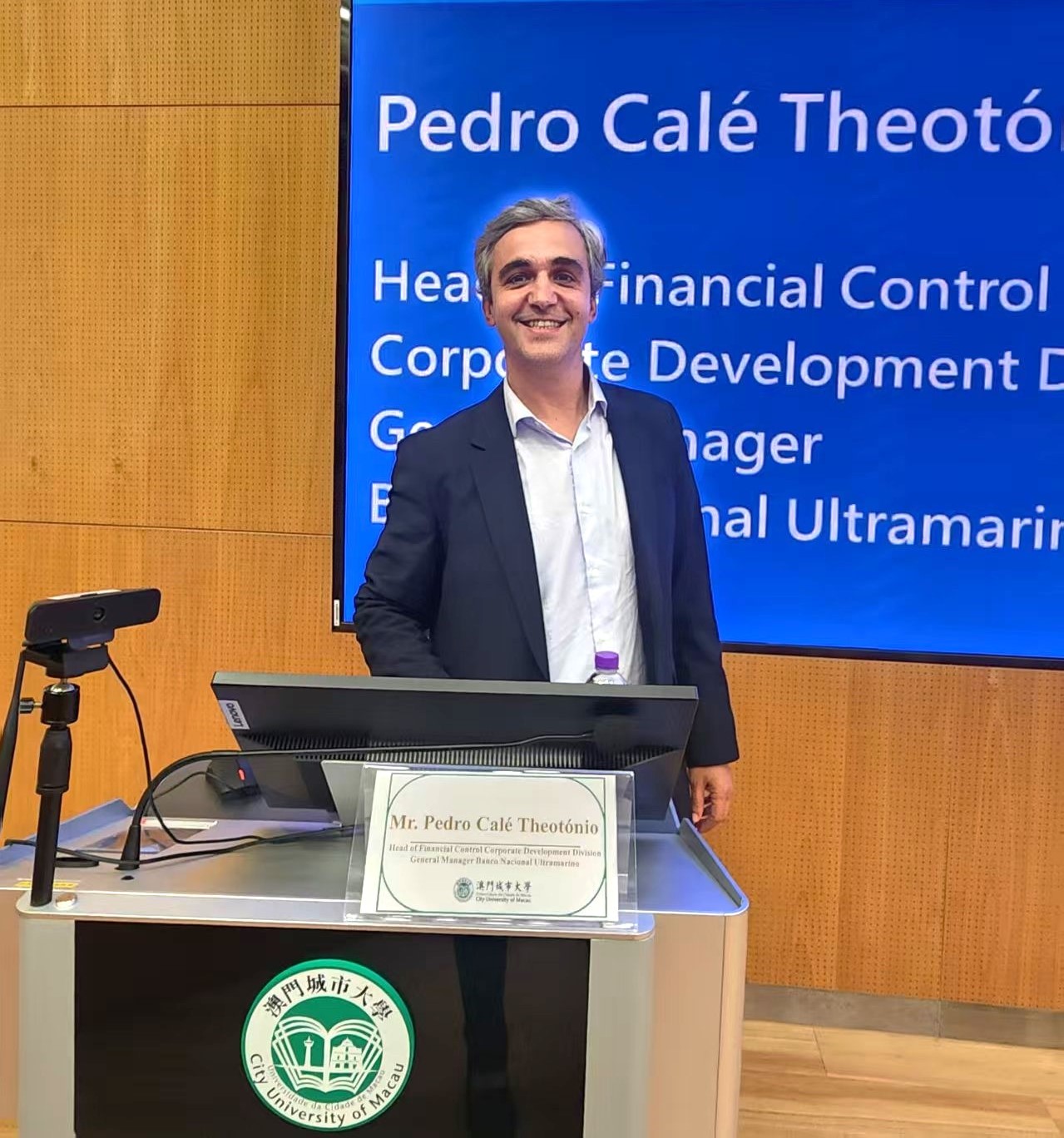
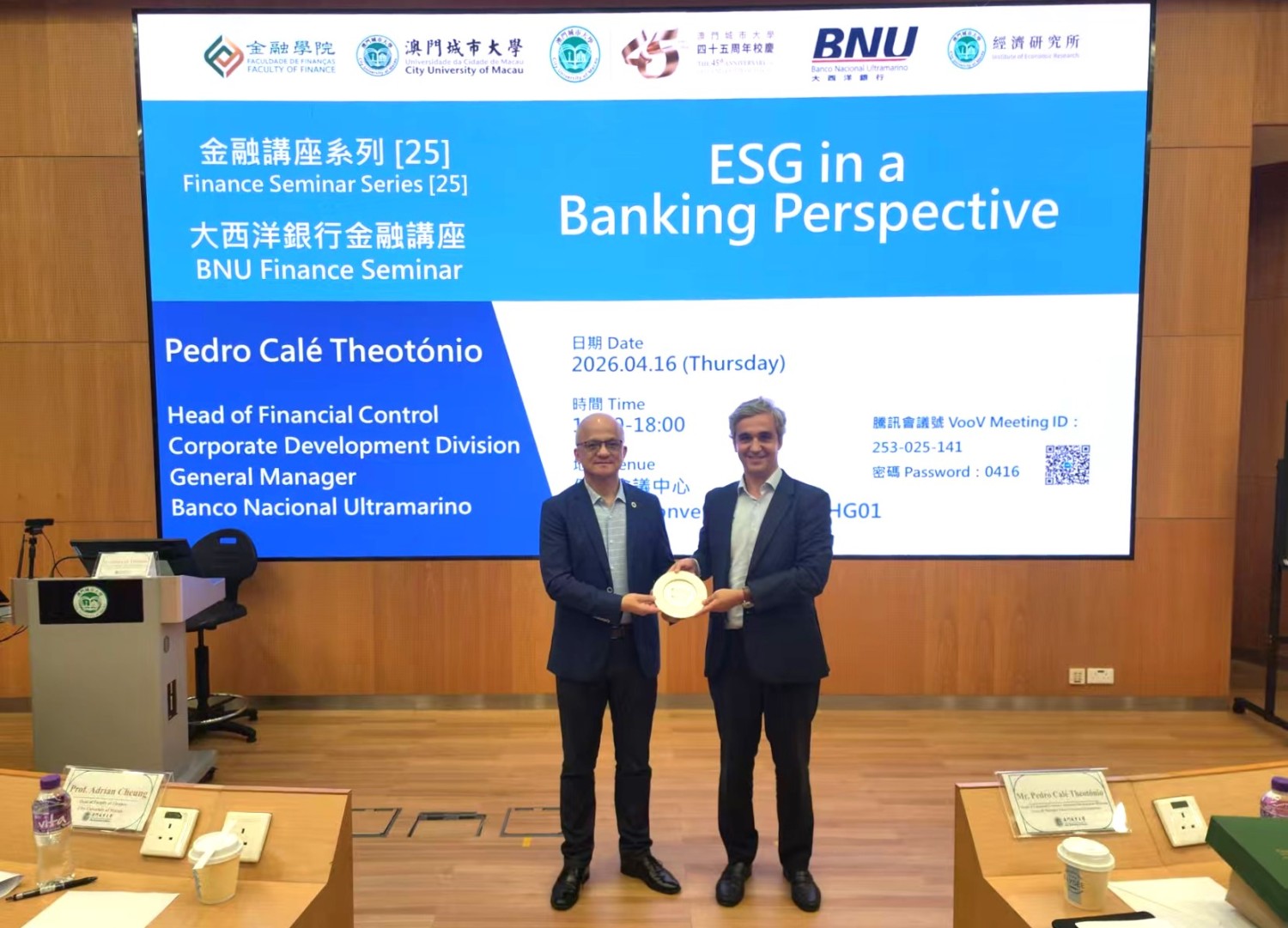
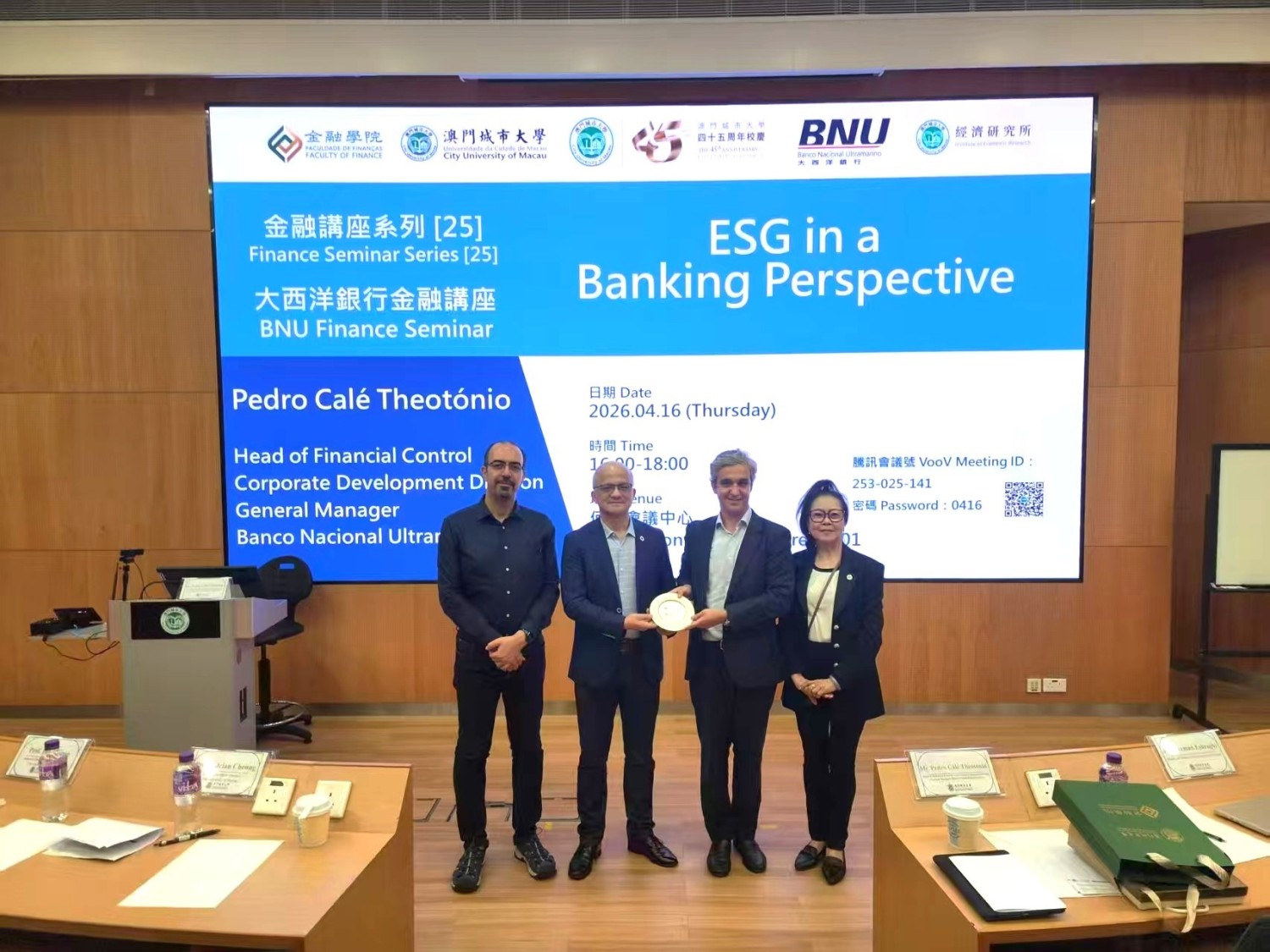
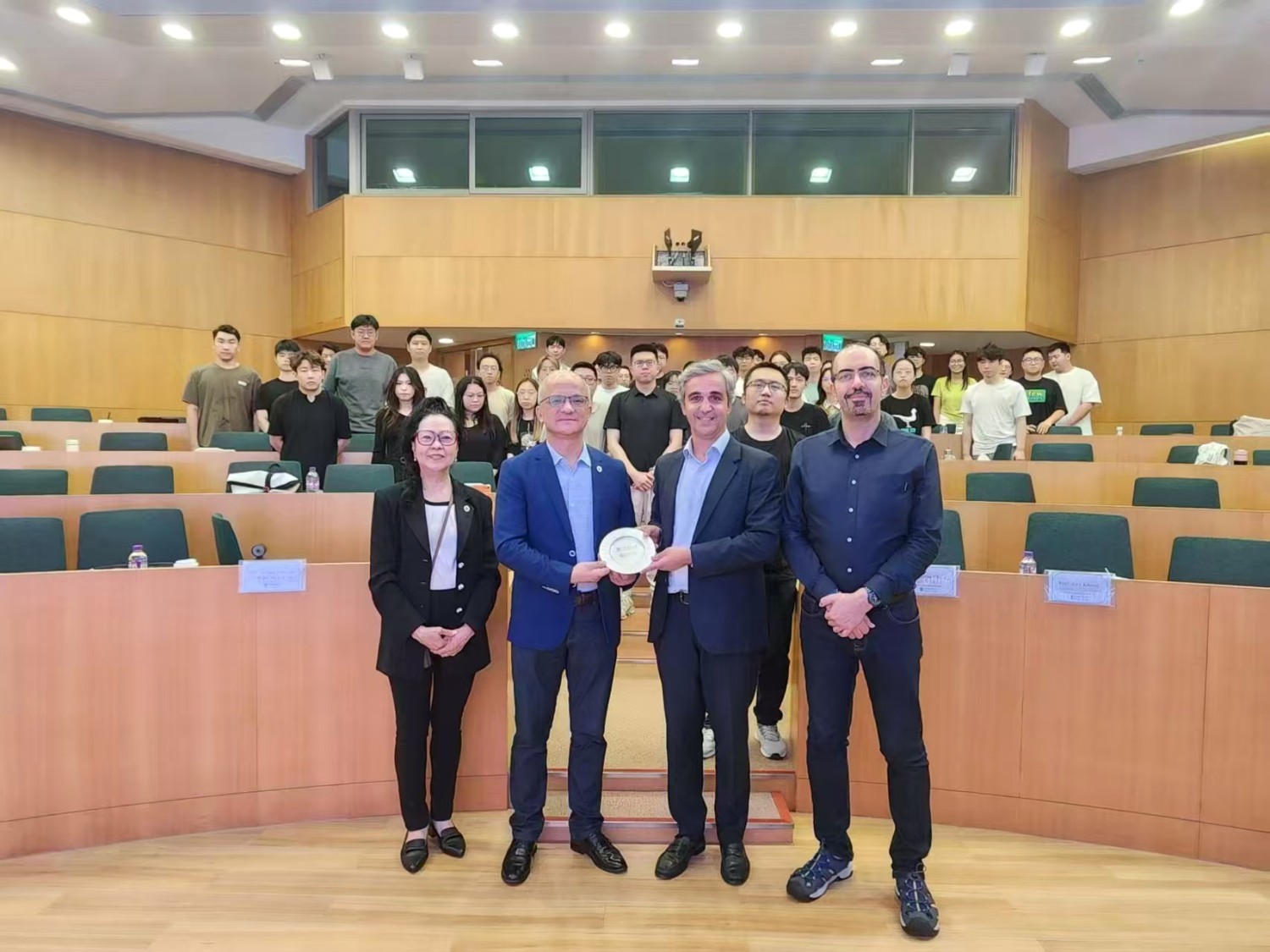
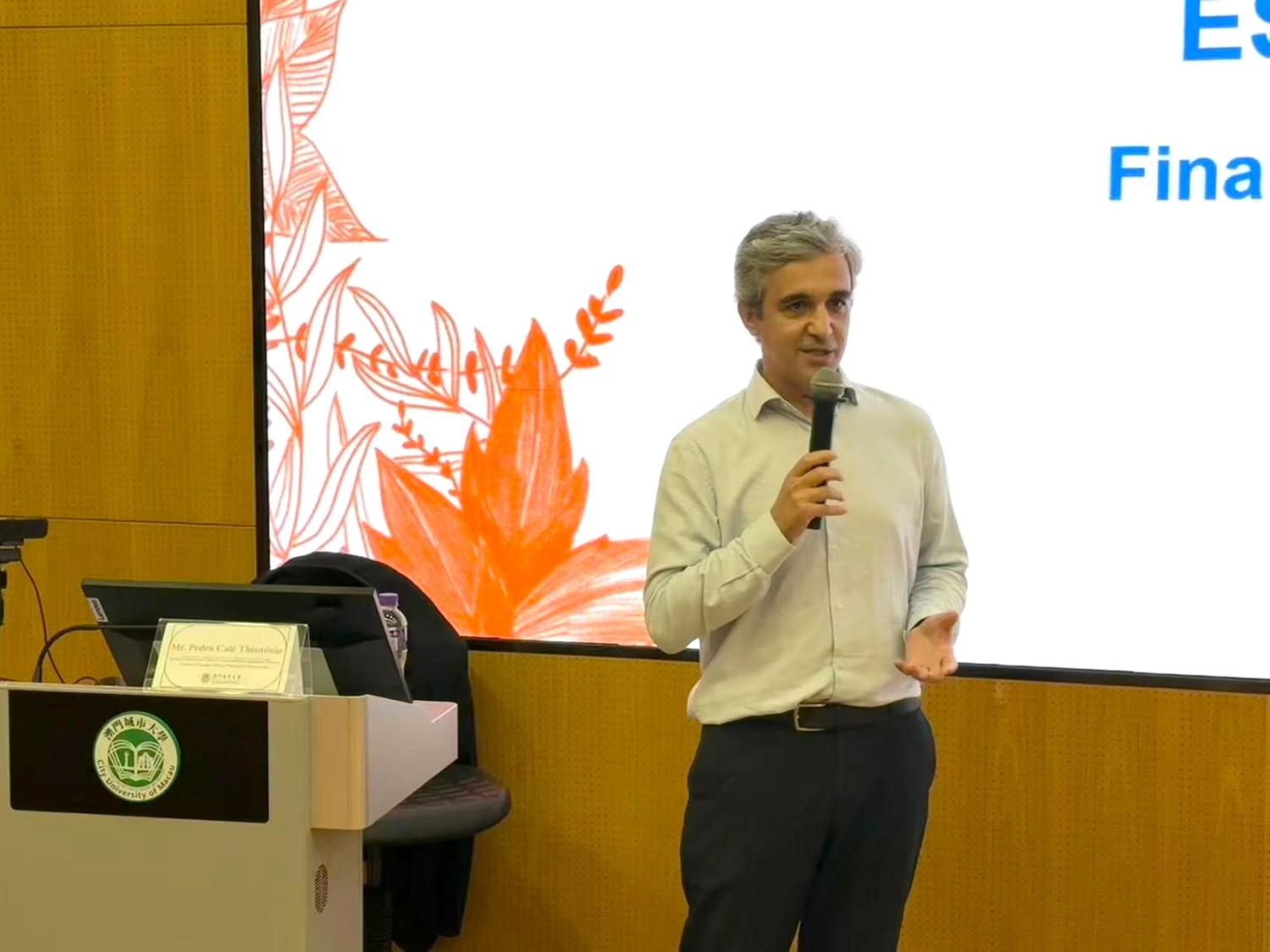
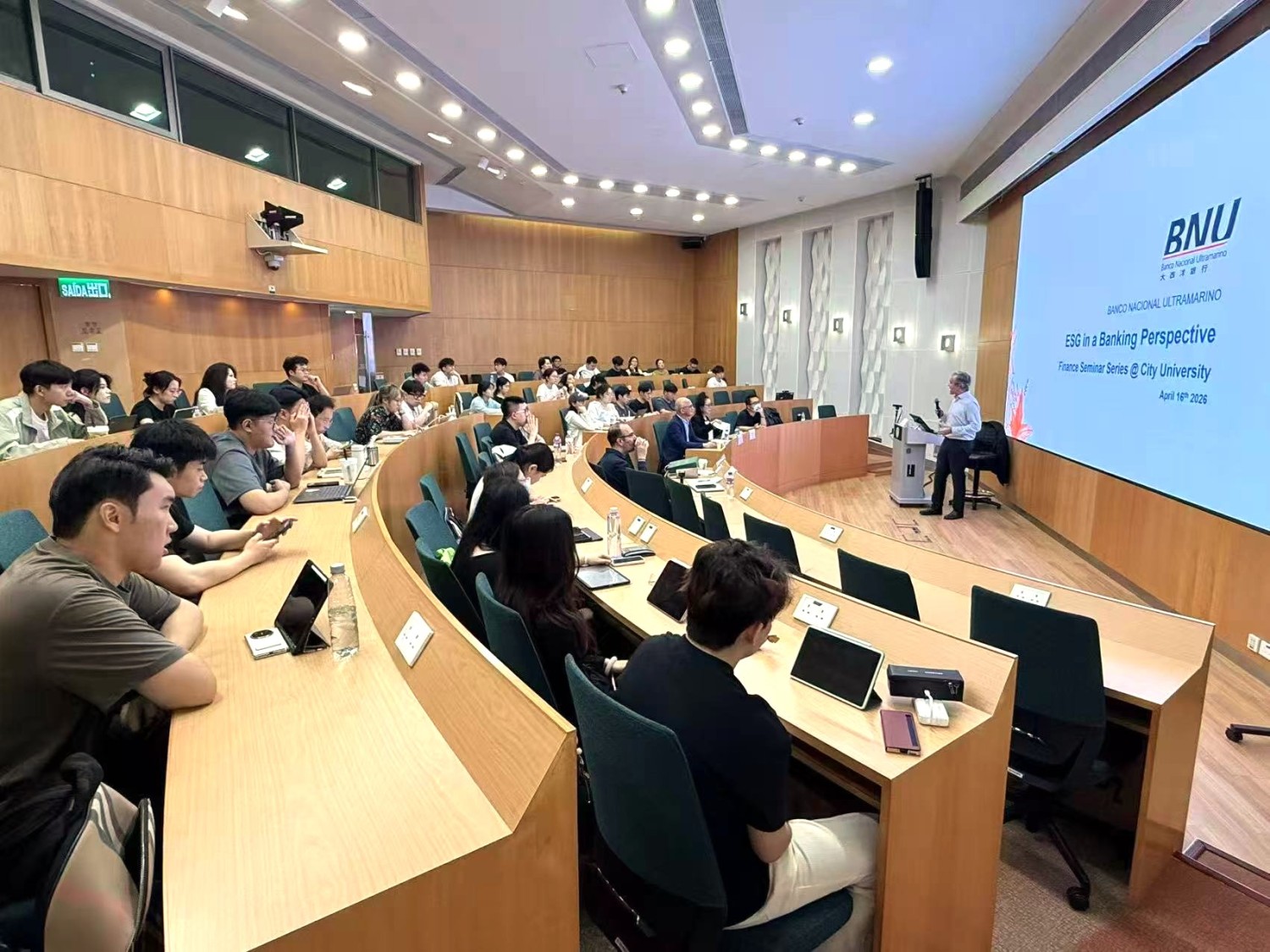
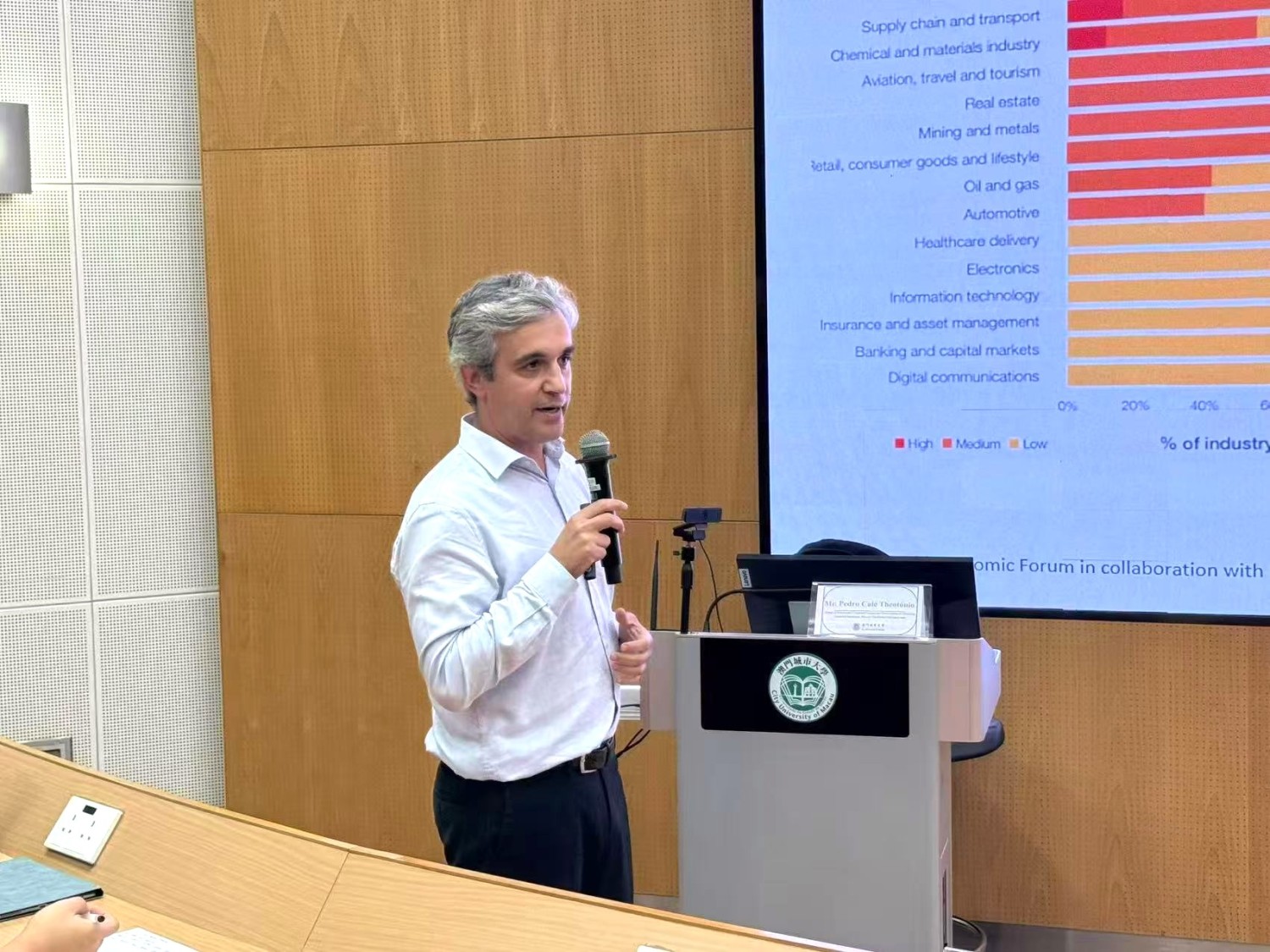
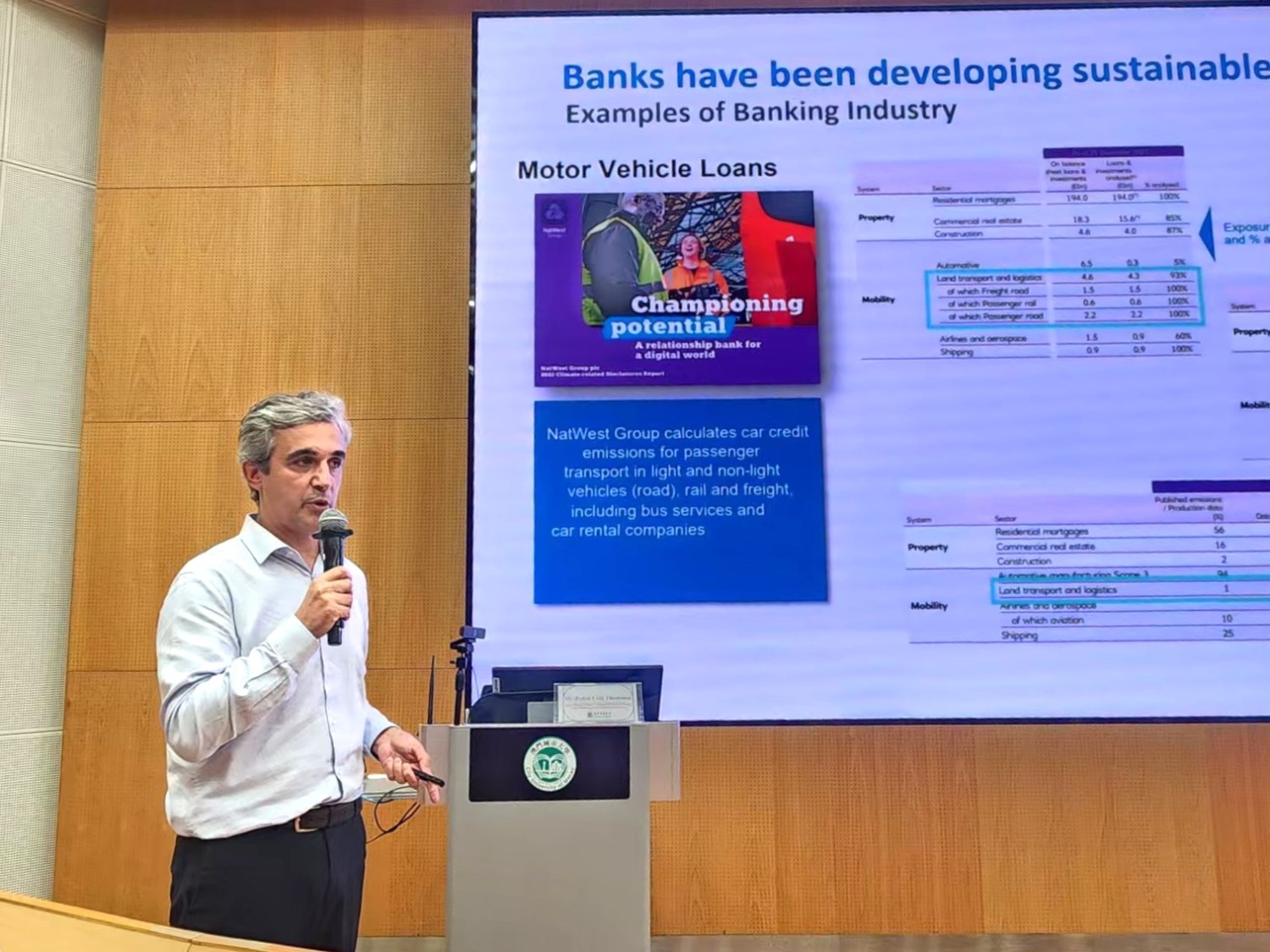
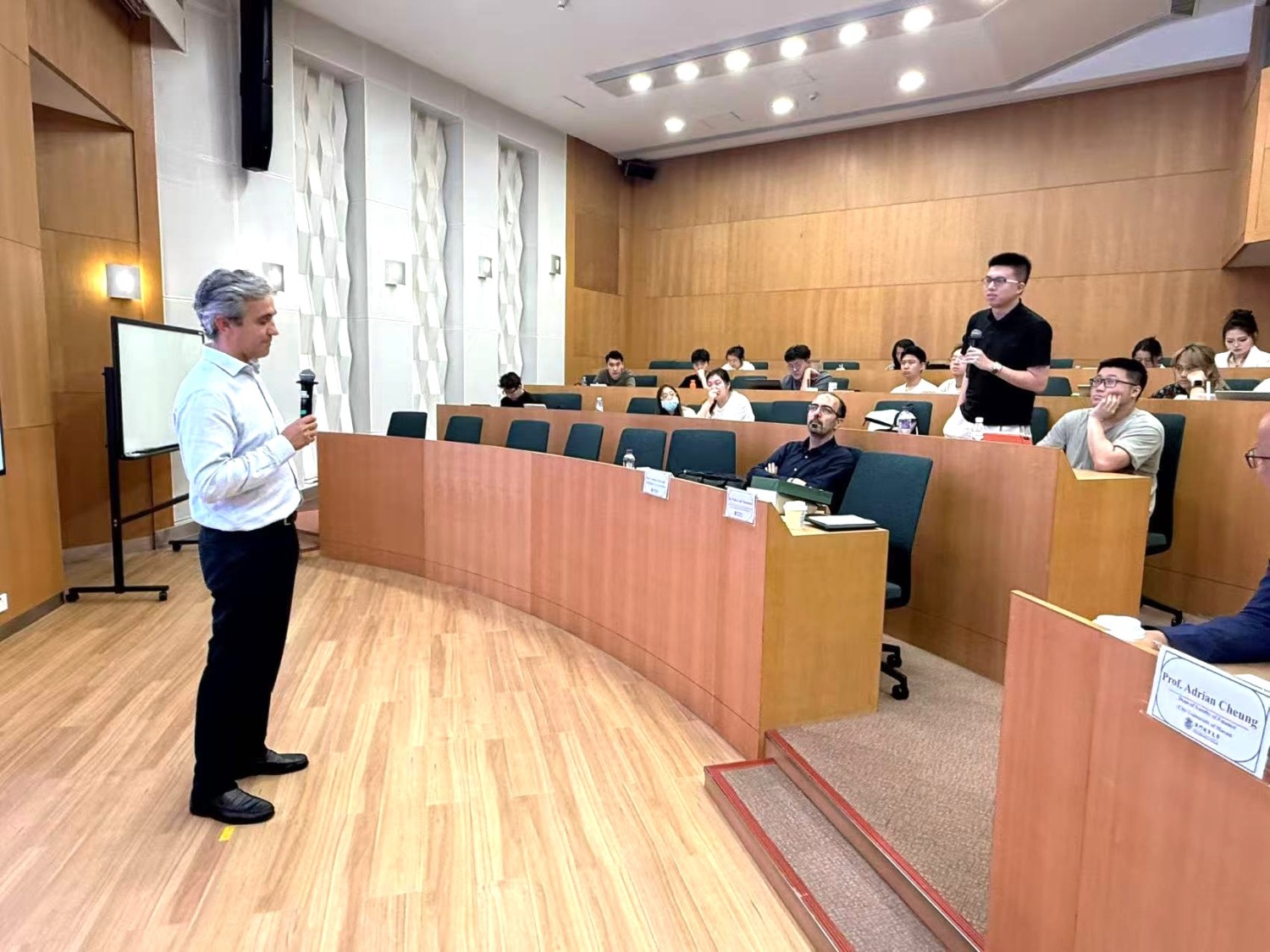
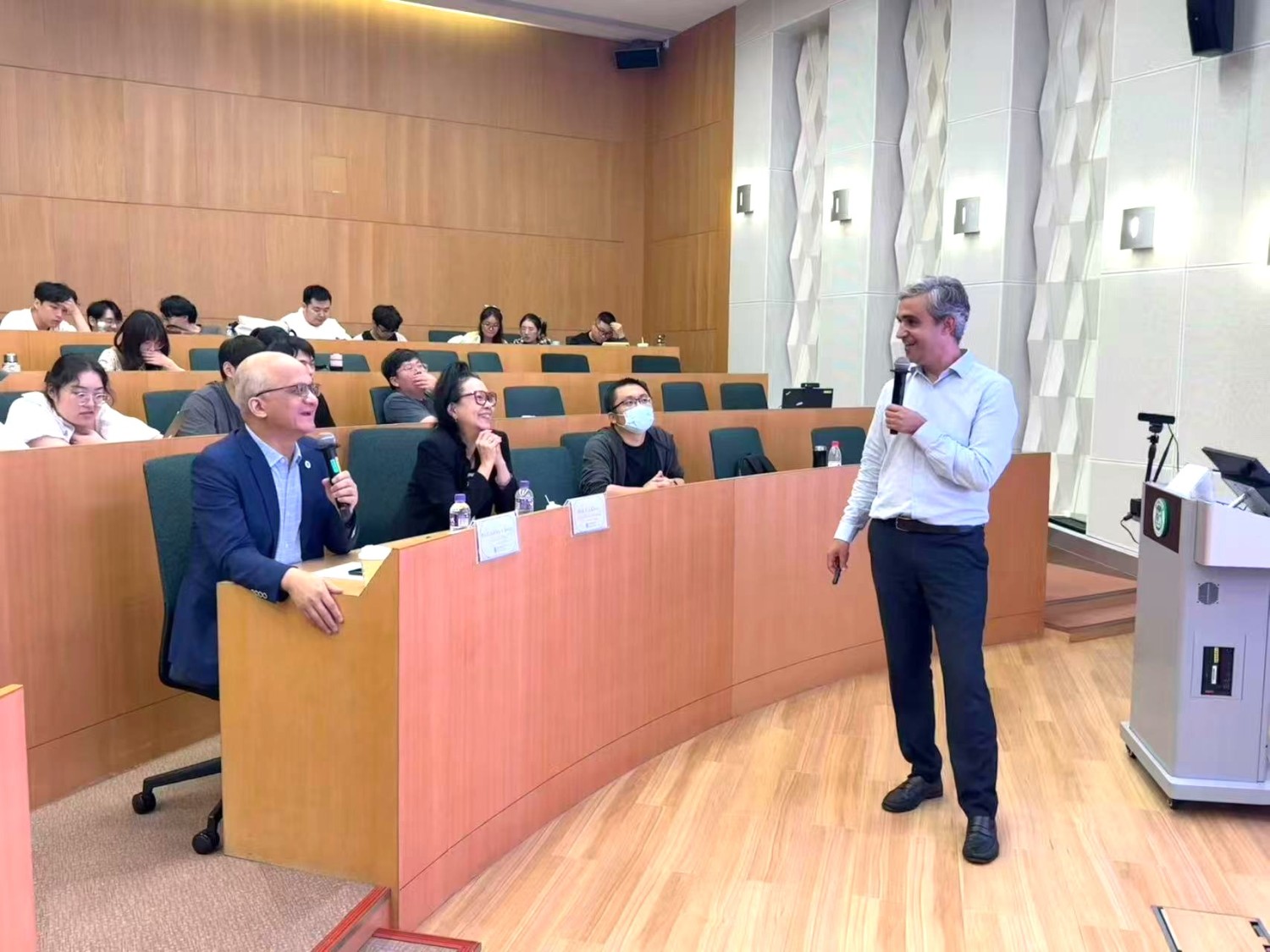
On April 16, 2026, the Faculty of Finance at City University of Macau held a finance seminar at Ho Yin Conference Center on Taipa Campus. The seminar featured Mr. Pedro Calé Theotónio, Head of Financial Control and Corporate Development Division, General Manager at Banco Nacional Ultramarino (BNU), was invited as the keynote speaker. The seminar focused on the theme "ESG in a Banking Perspective". Distinguished guests included Dean Adrian Cheung, Associate Dean Eva Khong and Professor Arman Eshraghi, Faculty of Finance.
Mr. Pedro Calé Theotónio is Head of Financial Control and Corporate Development Division, General Manager at Banco Nacional Ultramarino. He has Financial Advisers’ International Qualification granted by The Chartered Insurance Institute, he is also a member of the Chartered Public Accountant, CP Australia. Mr. Theotónio has very extensive experience in various ways, such as financial service, hospitality, health industry, energy, etc.
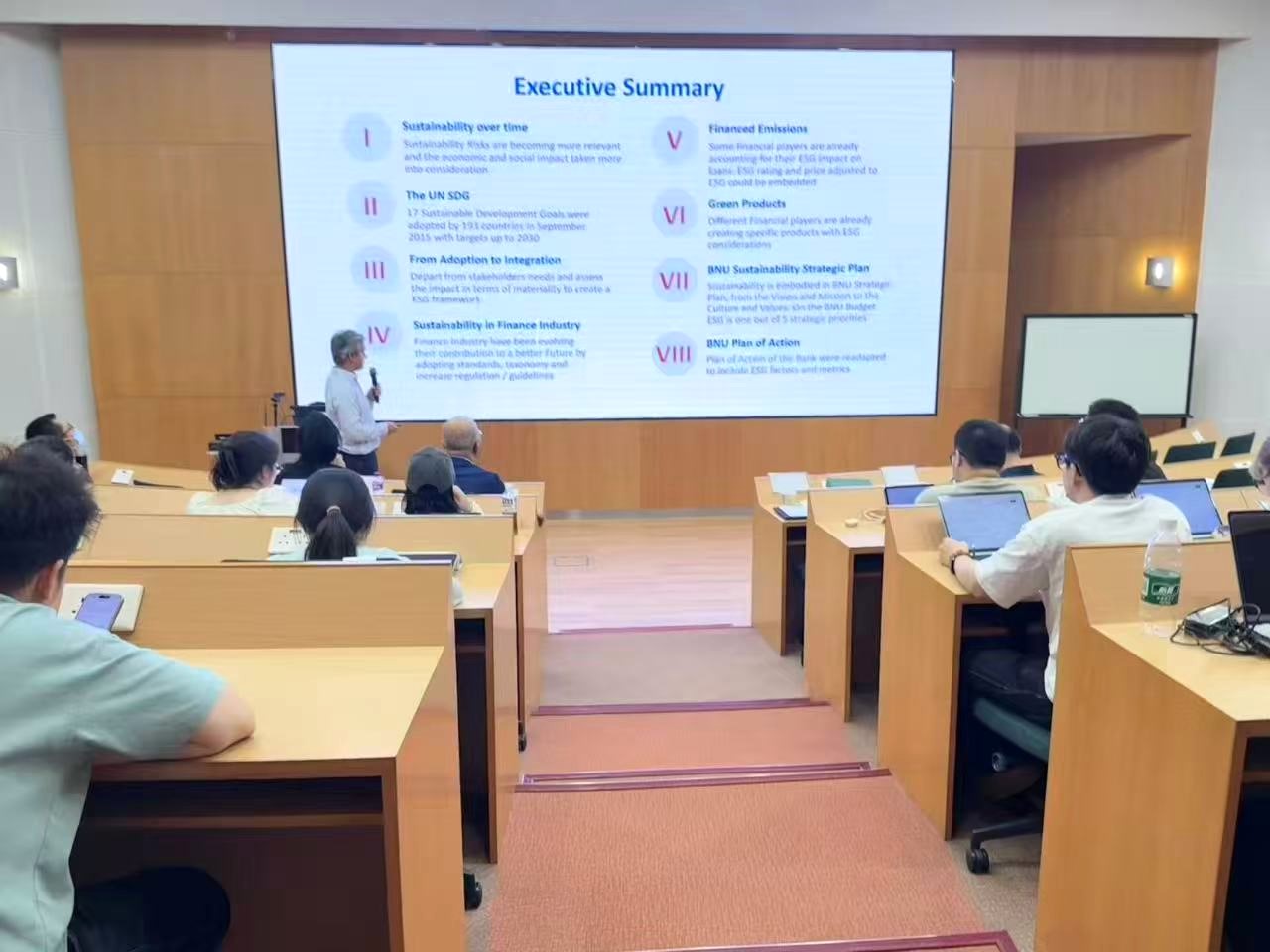
The seminar began with a historical review of sustainability, Mr. Theotónio pointed out that sustainability risks are becoming more relevant and the economic and social impact are taken more into consideration. Recent statistics show that environmental risks are becoming a top concern, with 55% of worldwide GDP is estimated to be exposed to environmental concerns. Regarding main ESG trends, risks, and opportunities, despite the growing legal and regulatory framework to control carbon emissions, when comparing the emission reduction trajectories and the GDP value, efforts and investments in reducing carbon emissions do not compromise economic growth. On the other hand, APAC (Asia-Pacific) sees annual growth in Sustainability Bonds, EMEA (Europe, Middle East, Africa) boosts Sustainability Loans. According to the World Economic Forum (2025), climate risks persist as environmental threats intensify over 10-Year Horizon. The 17 UN SDG were adopted in 2015. China targets peak CO₂ by 2030 and carbon neutrality by 2060, though the World Economic Forum estimates an earlier peak by 2025. Also, ecosystems and biodiversity are recognized as the foundation of society and the economy.
Mr. Theotónio mentioned that ESG maturity curve from adoption to integration, companies evolve through stages from “obligation” to “efficiency”. Early drivers include regulatory compliance and stakeholder pressure. Employees and regulation significantly influence climate action. A materiality matrix is essential. The AA1000AP standard emphasizes inclusivity, materiality, responsiveness, and impact. Regarding sustainability in the finance industry, the financial industry faces climate and environmental risks. European banks are exposed to physical and transition risks, requiring organizational ESG integration. At the same time, BNU develops its own approach to Green Finance. Financial industries are beginning to account for emissions from their loans. The PCAF standard provides a calculation formula. ESG ratings and price adjustments can be embedded into lending. Banks are developing sustainable finance products to direct capital toward projects that reinforce sustainable development. The first green bond was issued in 2008 by the World Bank, since then the green bonds market has developed in terms of standards. During the seminar, Mr. Theotónio introduced BNU Sustainability Strategic Plan, for the 2025-2028 cycle, the ambition is to strengthen the role of CGD (Caixa Geral de Depósitos) Group as a reference in the financial sector, ensuring the full integration of ESG criteria across all areas of operation, promoting the harmonization of practices within the Group, and supporting clients in transitioning to more sustainable business models. BNU initiated a Sustainability Survey reaching out to all stakeholders including customers, employees and the community to build a Materiality Matrix. BNU identified 6 most material topics from the Materiality Matrix. BNU finalizes ESG Rating Model following the CGD Approach, recognizing the Bank's crucial role in financing that integrates ESG criteria beyond traditional financial criteria. Therefore, BNU has been reinforcing ESG good practices by implementing different initiatives.
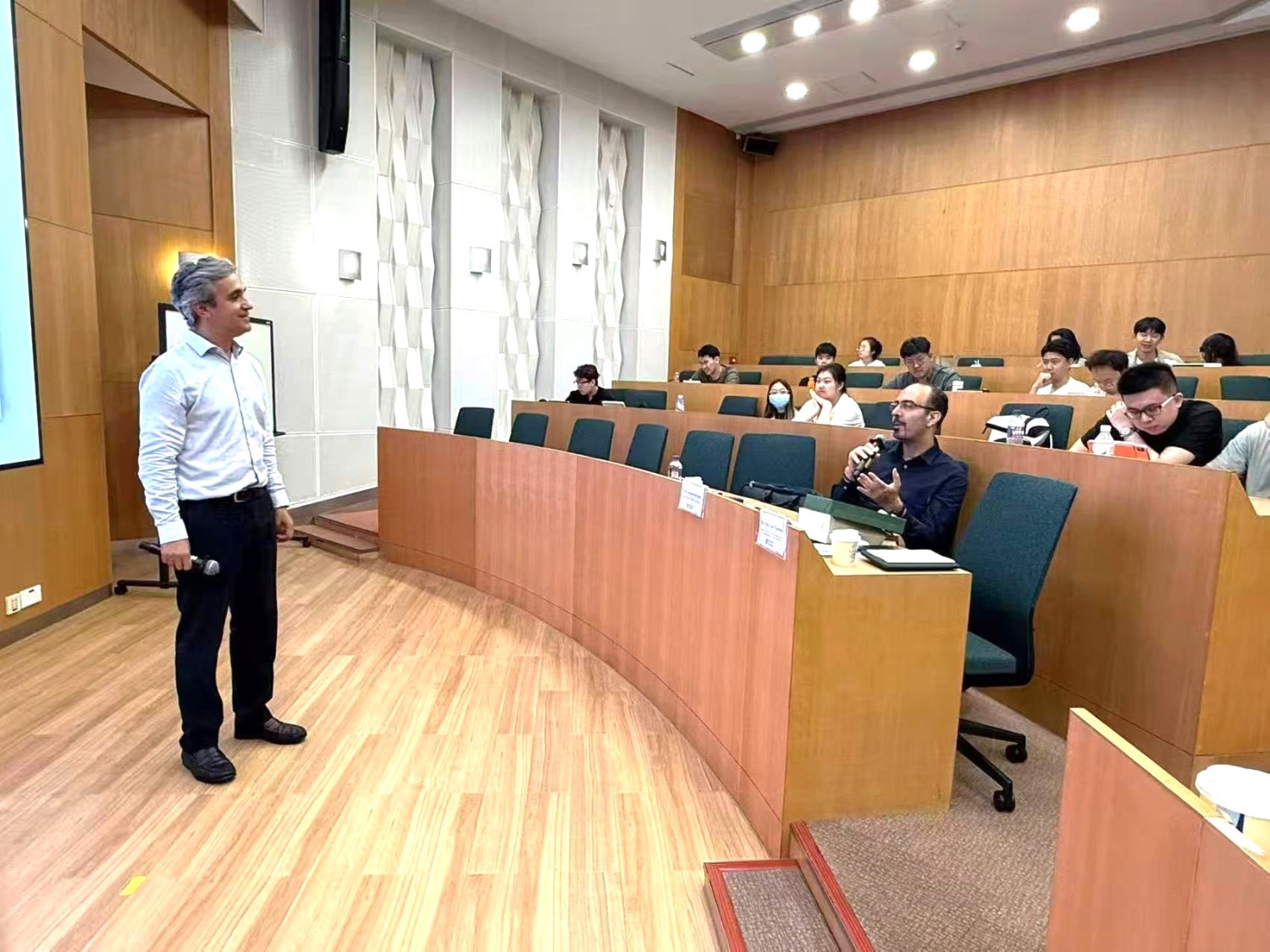
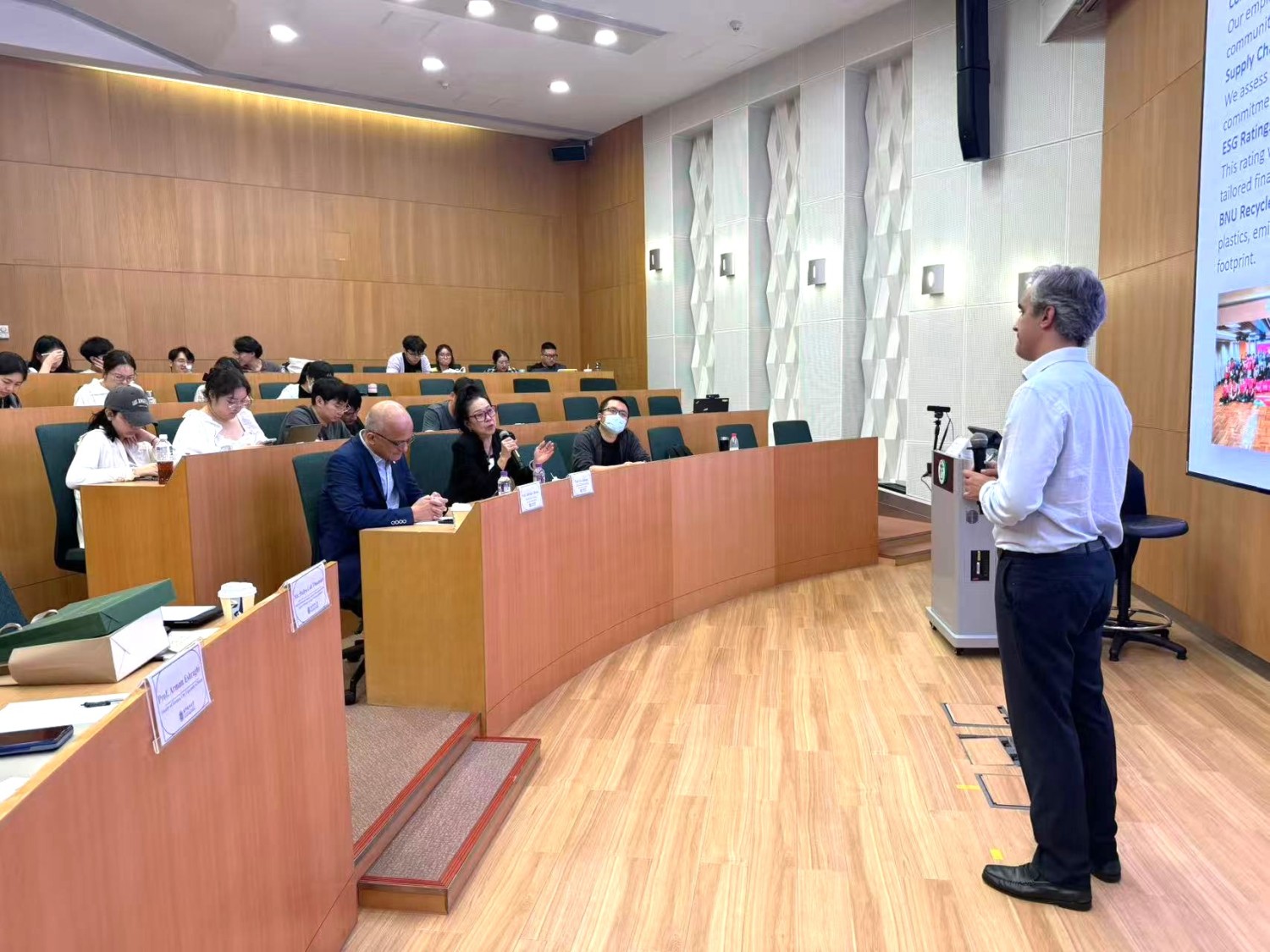
This seminar provided a comprehensive banking perspective on ESG, Mr. Pedro Calé Theotónio actively engaged with the faculty and students, participating students expressed that they greatly benefited from the seminar, not only deepened their understanding of ESG risks and opportunities but also strengthened their green finance knowledge. The faculty and students of the Faculty of Finance once again thanked Mr. Pedro Calé Theotónio for his wonderful sharing.