


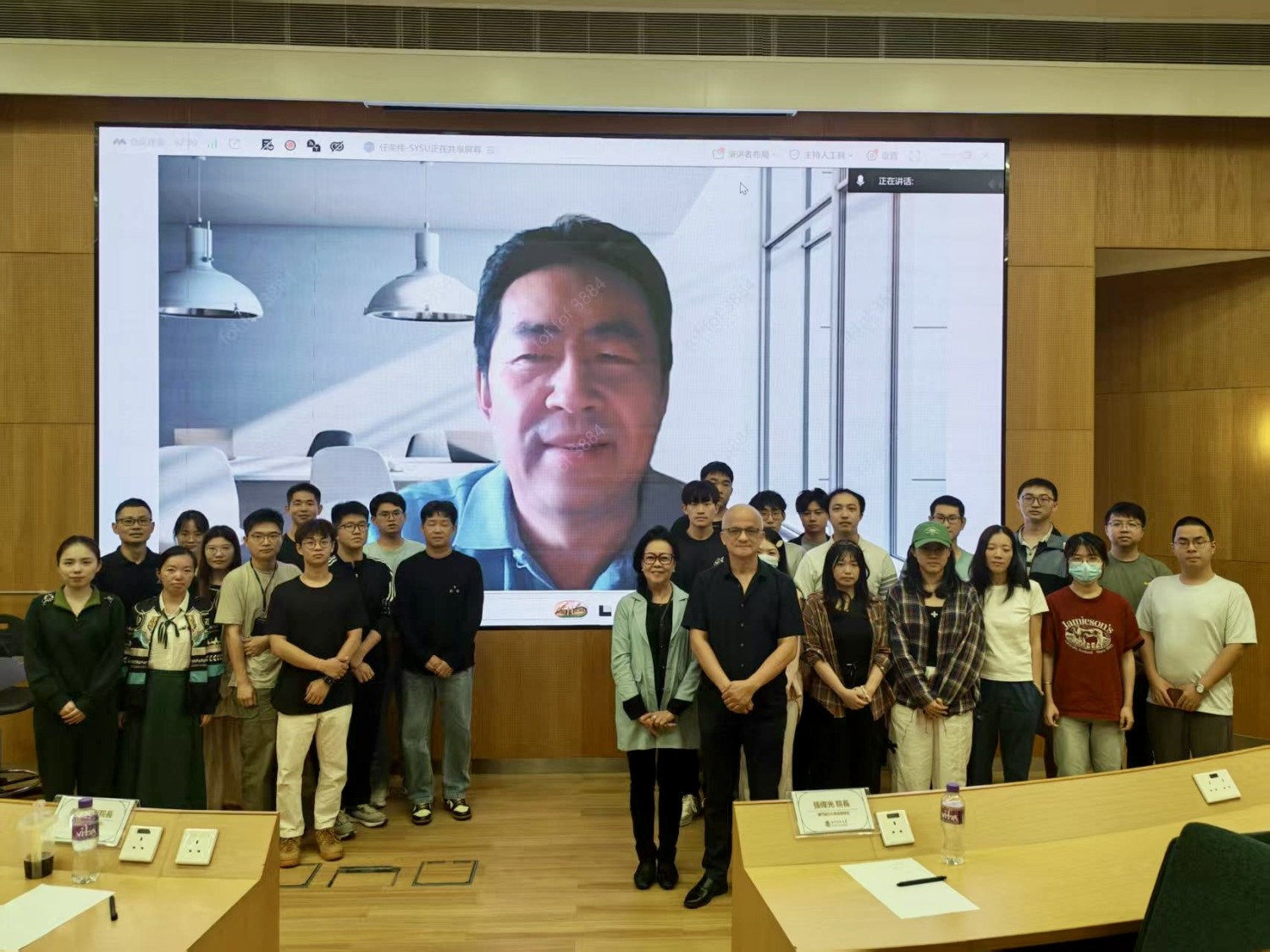
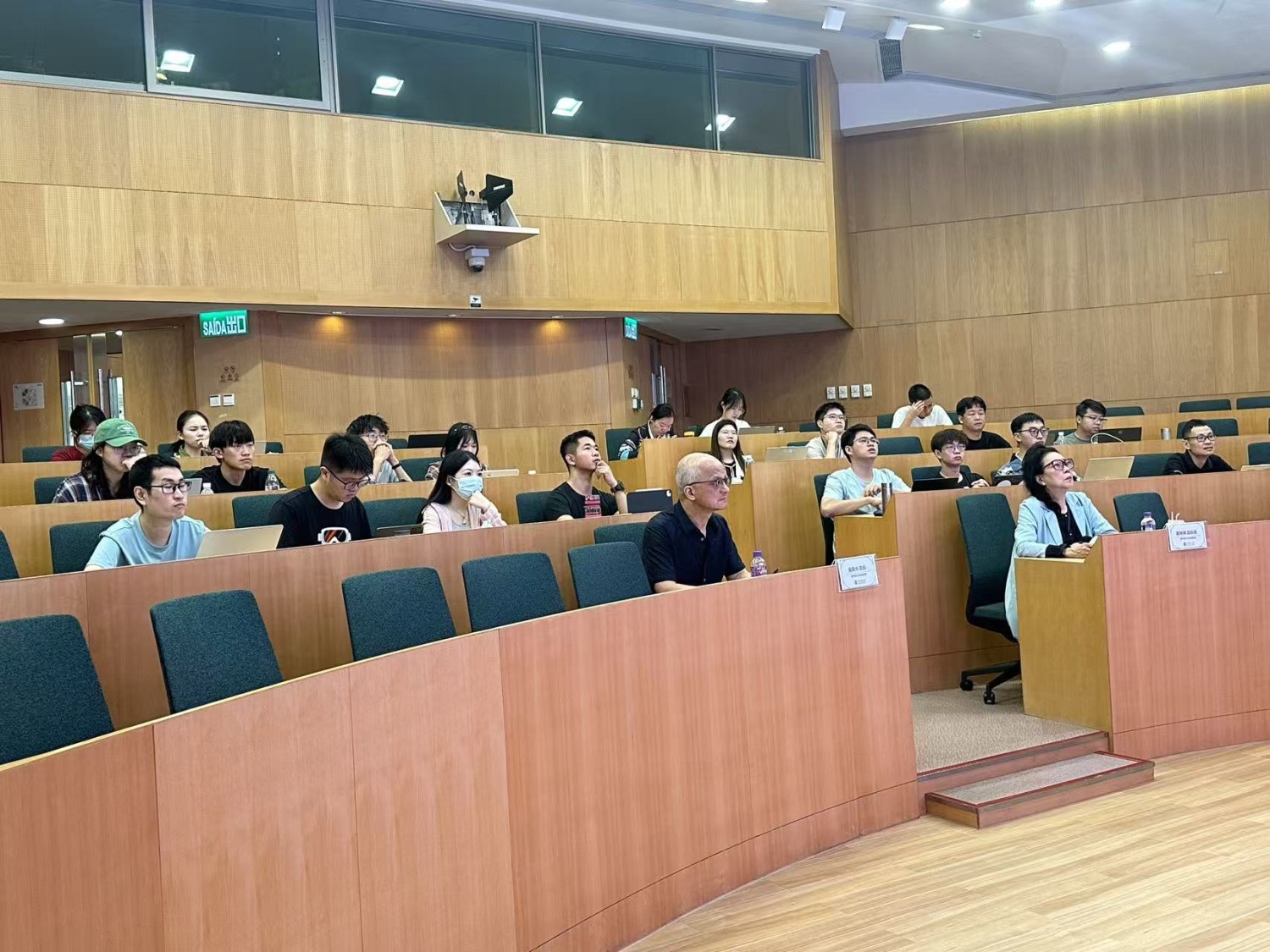
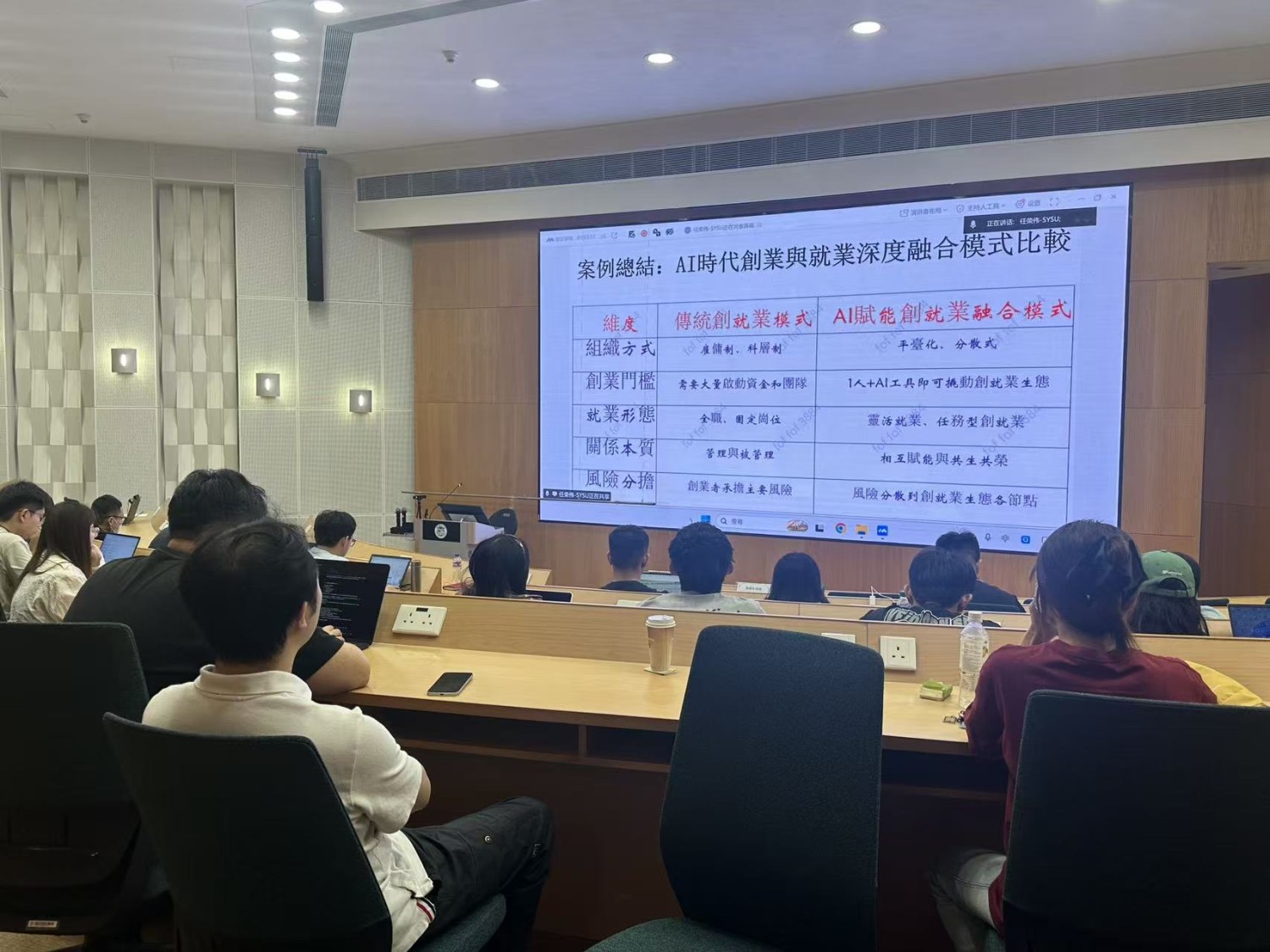
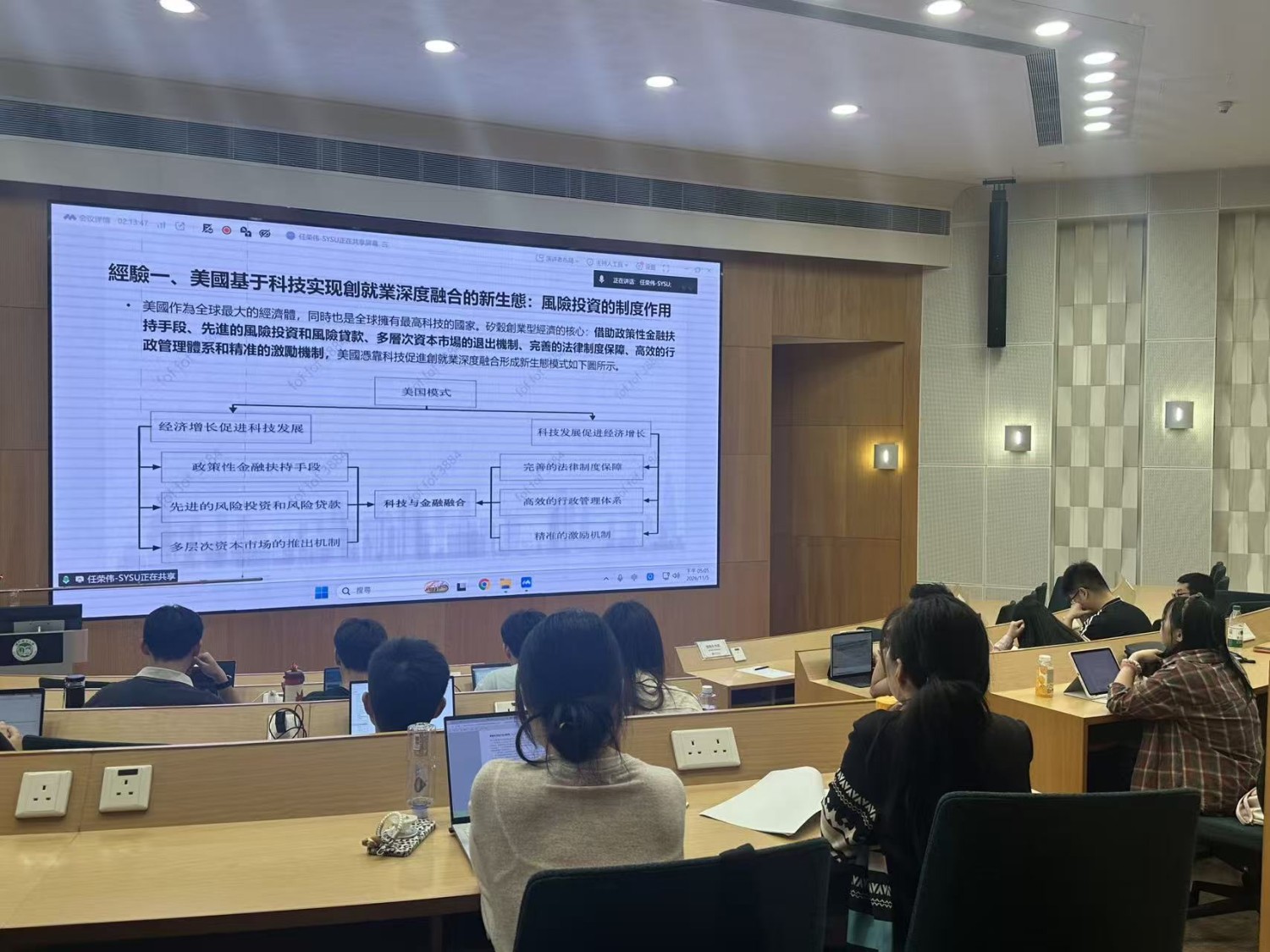
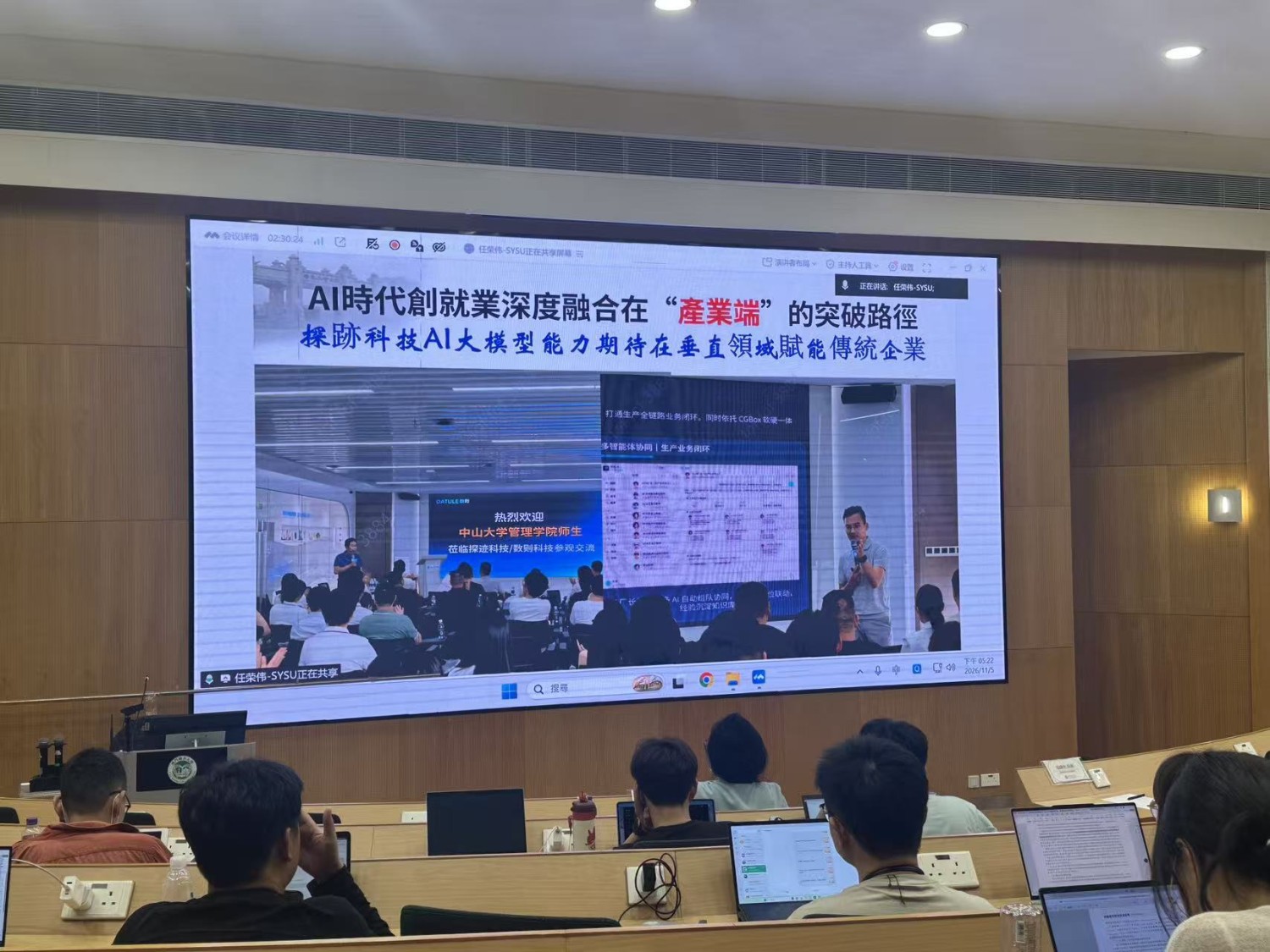
On November 5, 2026, the Faculty of Finance of City University of Macau held a finance seminar at Ho Yin Conference Center of Taipa Campus. Professor Ren Rongwei from the School of Business of Sun Yat-sen University as the distinguished speaker. The seminar focused on the theme “The Deep Integration of Employment and Entrepreneurship in the AI Era”. Distinguished guests included Dean Adrian Cheung and Associate Dean Eva Khong from Faculty of Finance of City University of Macau.
Professor Ren Rongwei holds a PhD in Management from Nanjing University and was a visiting scholar at the Department of International Development, University of Oxford. He is currently a Professor and Doctoral Supervisor at the School of Business of Sun Yat-sen University, Director of the Innovation and Entrepreneurship Education Office, Deputy Director of the Guangdong Provincial Employment and Entrepreneurship Steering Committee, and Distinguished Professor at City University of Macau. He is recognised by the Ministry of Education as one of the "Ten Thousand Outstanding Innovation and Entrepreneurship Mentors" nationwide and has received the Ministry of Education's "Baosteel National Outstanding Teacher Award" and the Guangdong Provincial "Nanyue Outstanding Teacher" honorary title.
Professor Ren has long been engaged in research on national innovation and entrepreneurship strategy theory and policy, venture capital management, and new venture growth. Multiple research outcomes have been adopted by the China Association for Science and Technology, the Communist Youth League Central Committee, and the Guangdong Provincial Party Committee and Provincial Government. He has published over 50 academic papers on innovation and entrepreneurship in prestigious domestic and international journals including AMP and Management World, and has authored multiple monographs, translated works, and textbooks. He has led and participated in numerous national and provincial/ministerial research projects funded by the National Natural Science Foundation of China, the National Social Science Fund of China, and the Humanities and Social Sciences Research Fund of the Ministry of Education.
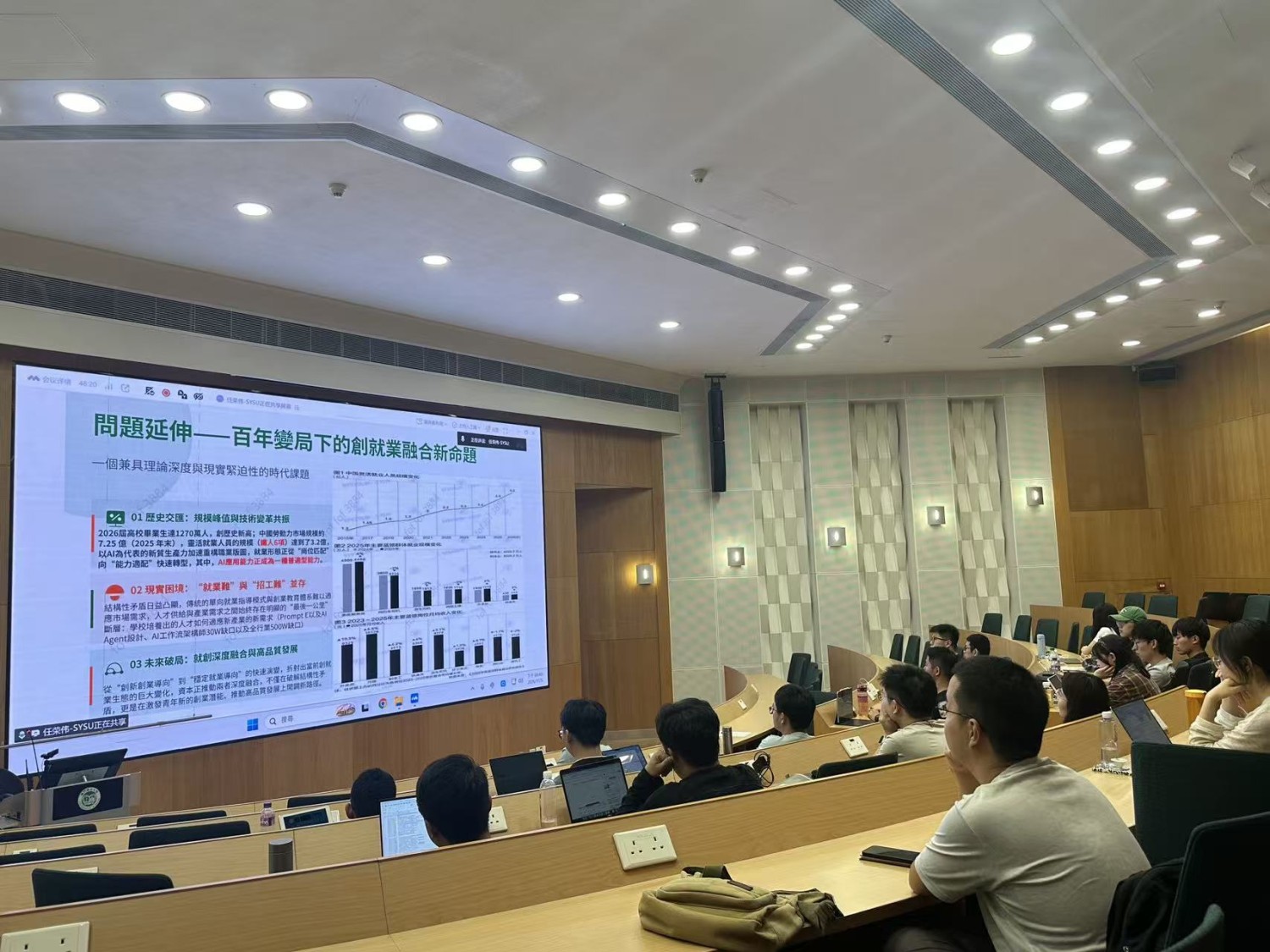
The first part of the seminar focused on framing the issue of deep integration of youth employment and entrepreneurship in the AI era. Professor Ren pointed out that we are at a historic inflection point, where new quality productive forces represented by AI are reconstructing the career landscape. Employment patterns are shifting from "job matching" to "competency alignment," with AI application capability becoming a universal personal competency. Meanwhile, the job market exhibits a structural contradiction characterised by the coexistence of "difficulty in finding employment" and "difficulty in recruitment." The way forward lies in the deep integration of employment and entrepreneurship and high-quality development. Professor Ren also referenced global unicorn industry rankings, identifying AI, health technology, and e-commerce as constituting the new quality industrial blue ocean. He elaborated on the structural impact of venture capital projects on employment and entrepreneurship from four dimensions: career choice, skills upgrading, investment perspective, and risk awareness.
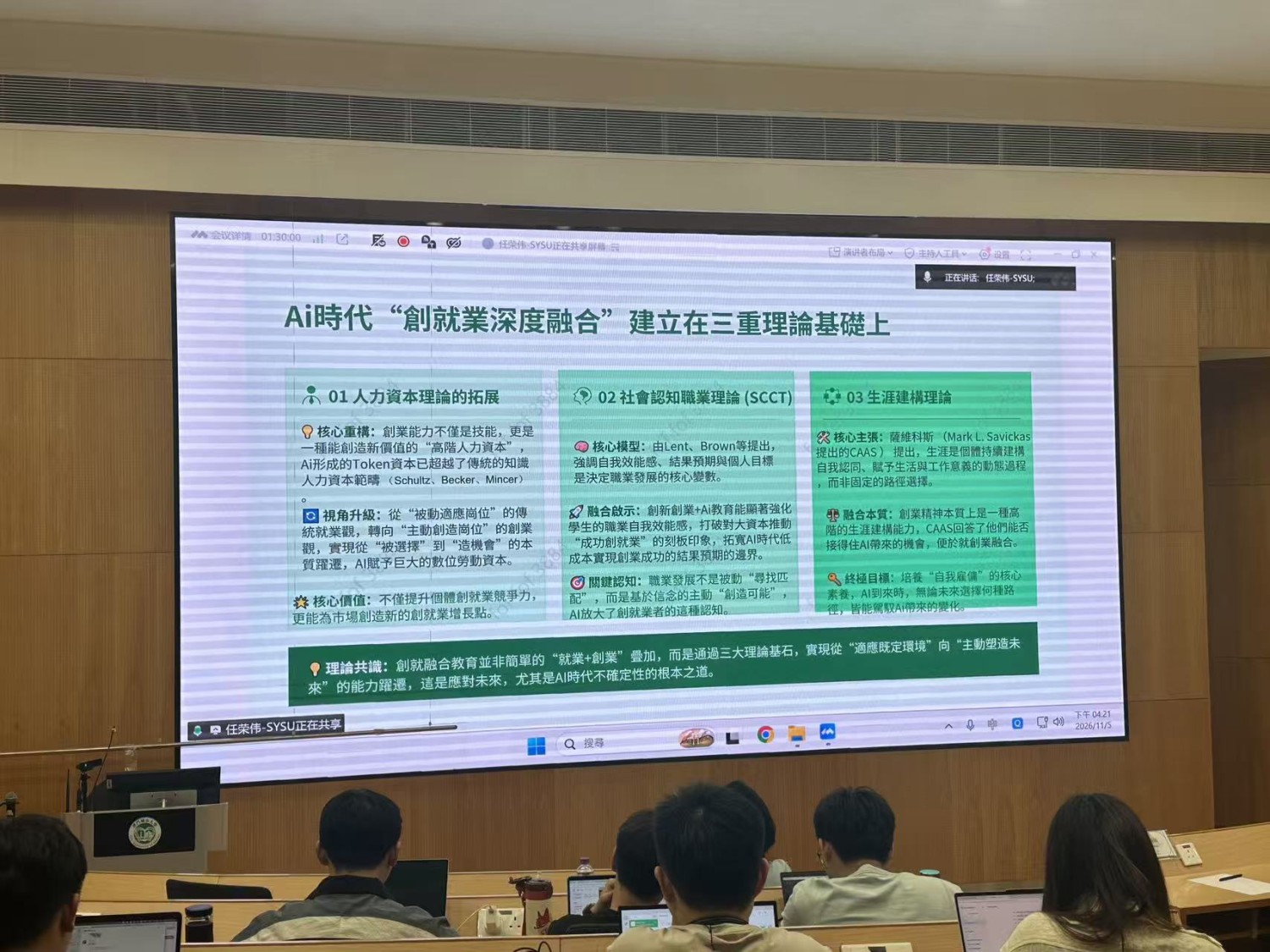
Professor Ren noted that the essence of deep integration of employment and entrepreneurship is as follows: employment education focuses on passively adapting to available positions, while entrepreneurship education emphasises actively creating positions. The deep integration of the two involves systemic penetration across the entire framework, achieving deep coupling with professional education, career guidance, and career development. Its core objective is to form a virtuous cycle of "innovation leading entrepreneurship, entrepreneurship driving employment, and employment reinforcing growth," realising the co-creation of personal and social value. Its essence lies in the reconstruction of concepts and models and the organic integration to form a reaction mechanism, achieving educational outcomes where "1+1>2." He stated that the "deep integration of employment and entrepreneurship" in the AI era is grounded in three theoretical foundations: human capital theory, social cognitive career theory, and career construction theory. A theoretical consensus has been reached: integrated employment-entrepreneurship education is not simply the superposition of "employment + entrepreneurship," but rather, through these three theoretical cornerstones, achieves a capability leap from "adapting to given environments" to "proactively shaping the future"—this is the fundamental approach to addressing uncertainty in the future, particularly in the AI era.
The second part of the seminar centred on building a new ecosystem for youth employment-entrepreneurship integration in the AI era. Professor Ren pointed out that industrial competitiveness derives from the concentration of four key elements: new technology, capital, talent, and institutions. He then proposed systematic reform pathways from the institutional, capital, industrial, and educational dimensions respectively: at the institutional level, improving the OPC (One-Person Company) full-lifecycle service system; at the capital level, incorporating employment elasticity into the assessment of guiding funds, addressing the financing gaps of asset-light startups through first-order scenario support, guiding capital to create jobs along the industrial chain, and establishing a linkage mechanism between industry trends and academic programme design; at the industrial level, relying on AI large models to empower traditional enterprises in vertical industries and unlock employment opportunities; and at the educational level, promoting deep integration across three dimensions—curriculum system, practical platforms, and faculty development. He also introduced the Sun Yat-sen University Entrepreneurship Huangpu Programme 2.0 training model, which adopts a boundaryless interdisciplinary cultivation approach suitable for both national needs and OPCs, targeting emerging social demands and cultivating future-oriented interdisciplinary composite talents. In his concluding remarks, Professor Ren noted that in the era of AI large models, a major global trend of deep integration of employment and entrepreneurship has emerged. He called on young people in the Guangdong-Hong Kong-Macao Greater Bay Area to seize the development opportunities brought by AI-empowered new industries and achieve new personal breakthroughs.
The seminar concluded successfully in a warm atmosphere of exchange. Faculty and students of the Faculty of Finance expressed their sincere gratitude to Professor Ren for his wonderful and inspiring sharing. The seminar opened up a new perspective for faculty and students to understand the integration of AI with employment and entrepreneurship, enabling everyone to develop a more three-dimensional and profound understanding of career choices, entrepreneurial opportunities, and talent cultivation models under the wave of new technologies. It also provided valuable references for students in career planning and innovative practice. Participating faculty and students look forward to the Faculty continuing to organise more thematic seminars, maintaining focus on hot topics such as AI development and youth employment and entrepreneurship, and building more platforms for academic exchange and intellectual collision, helping City University of Macau faculty and students stay abreast of industry frontiers, seize development opportunities in the digital-intelligent era, and inspire more young people to identify their development direction, explore courageously, and practise actively in the new era empowered by AI.