


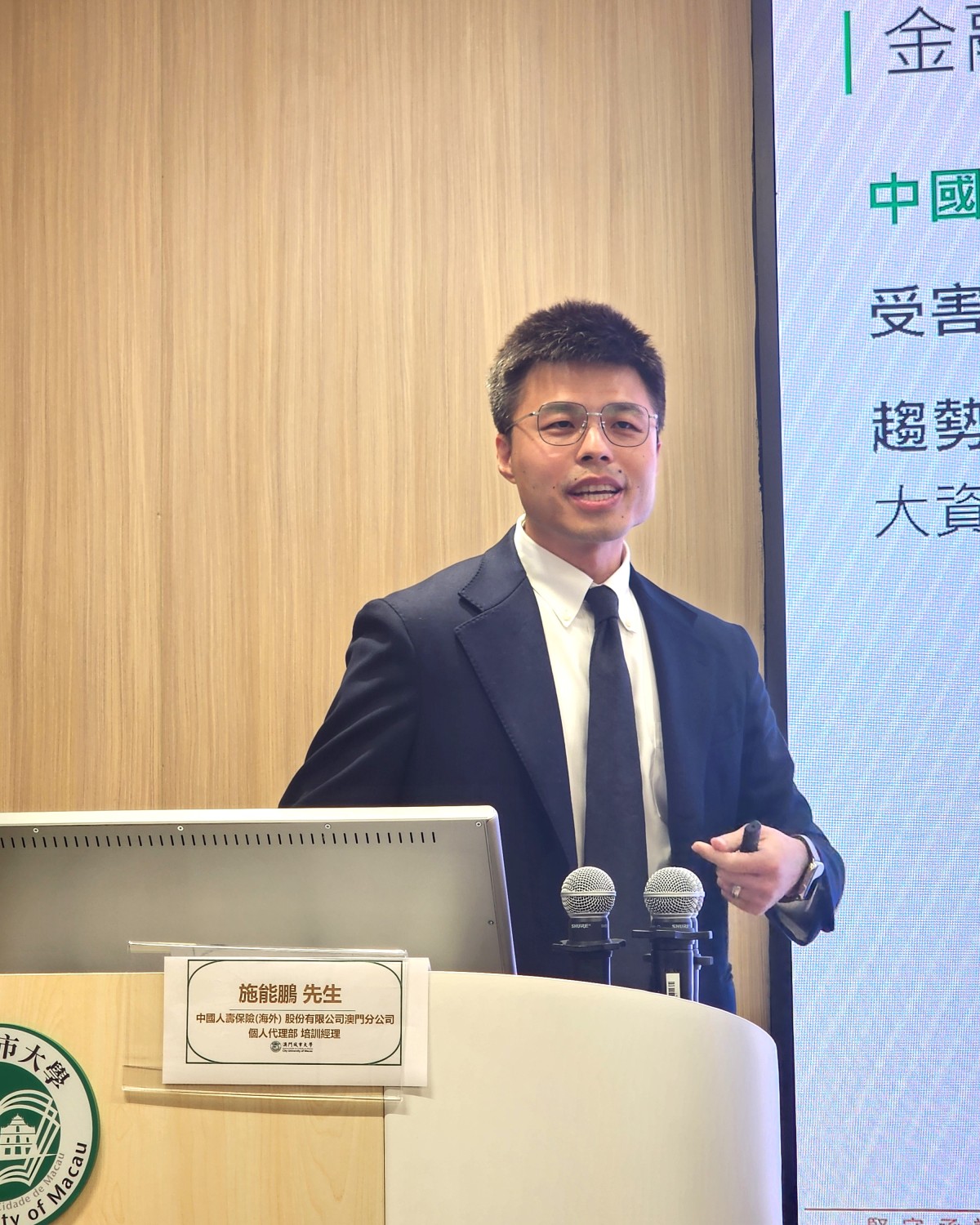
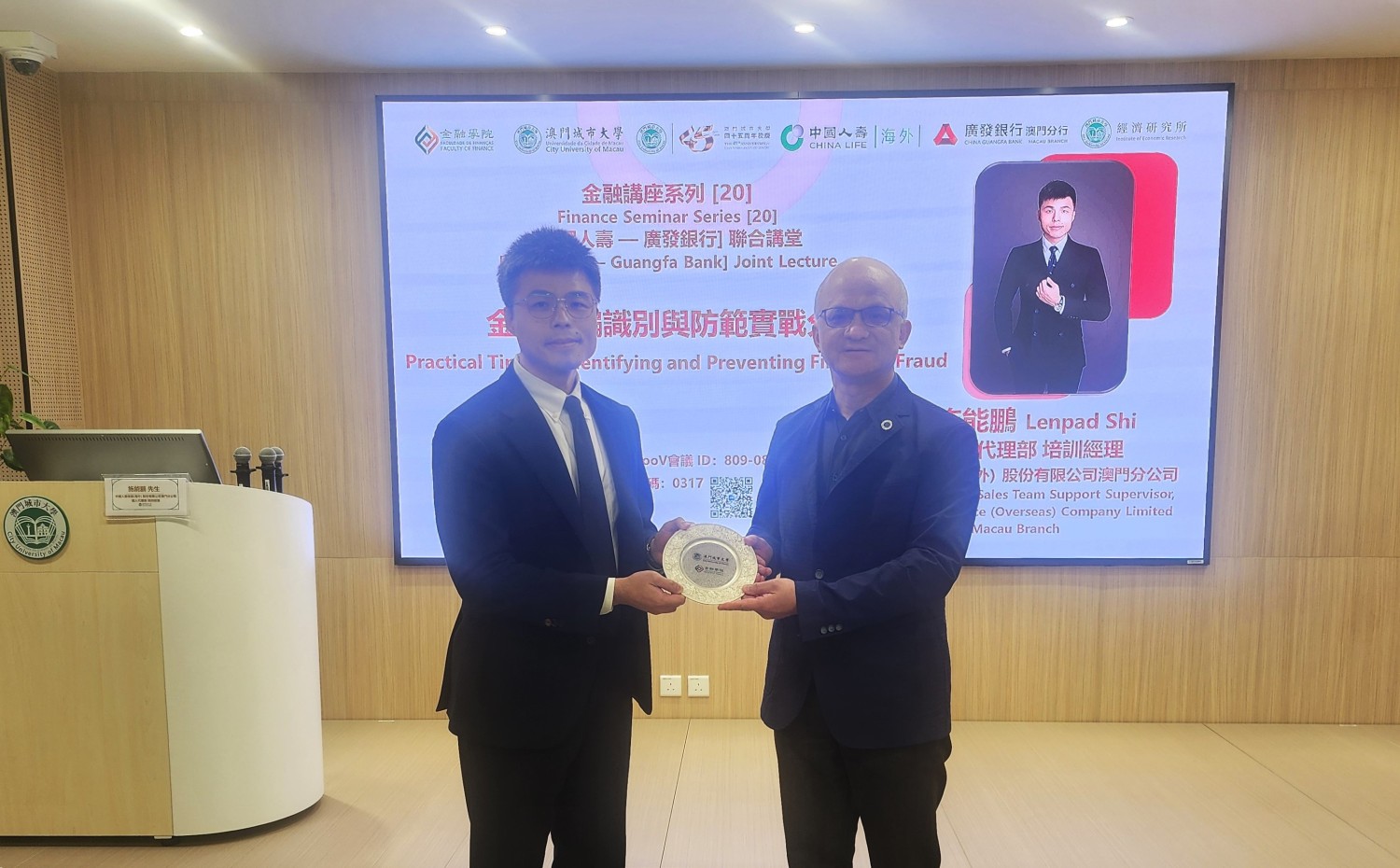
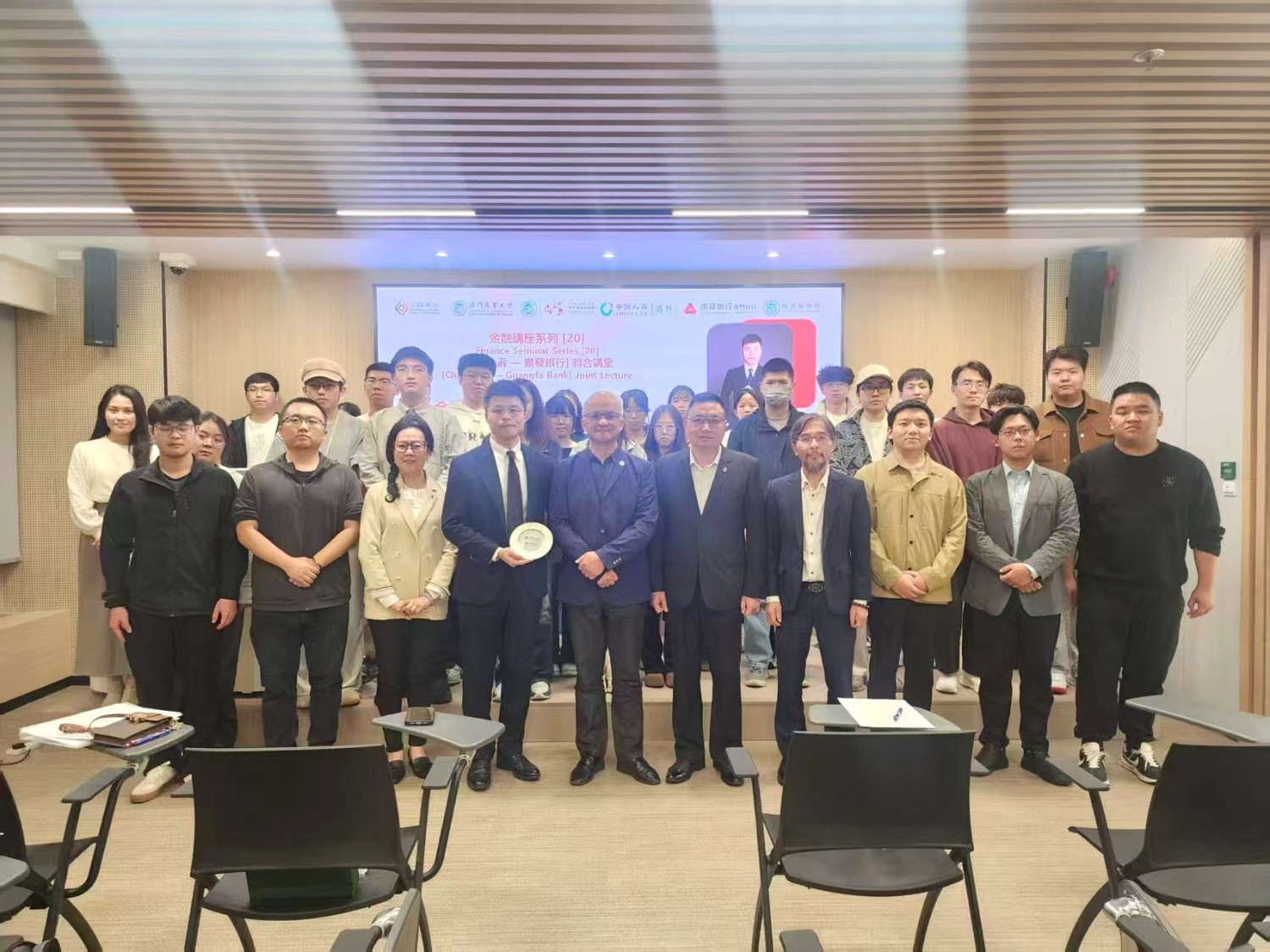
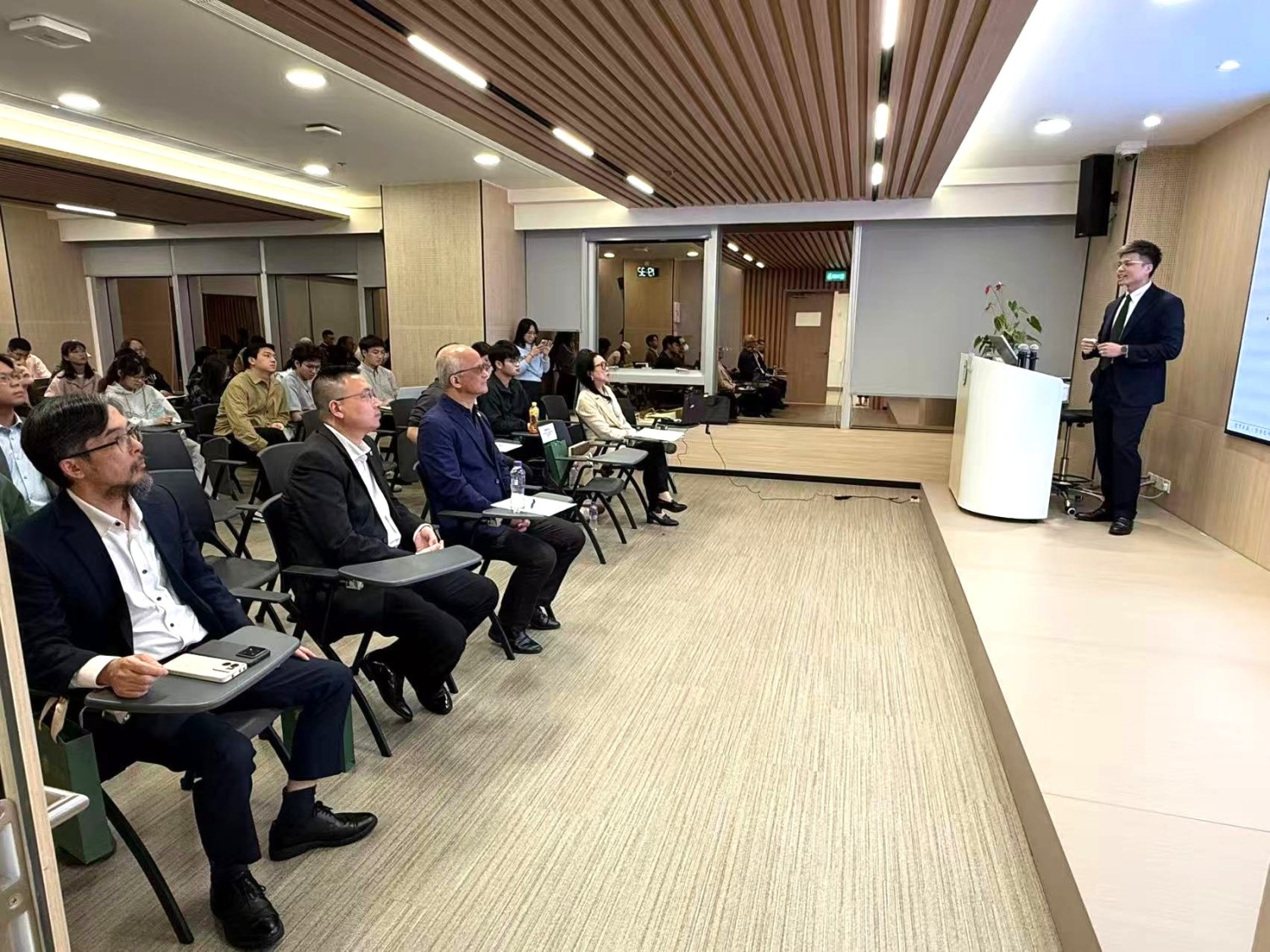
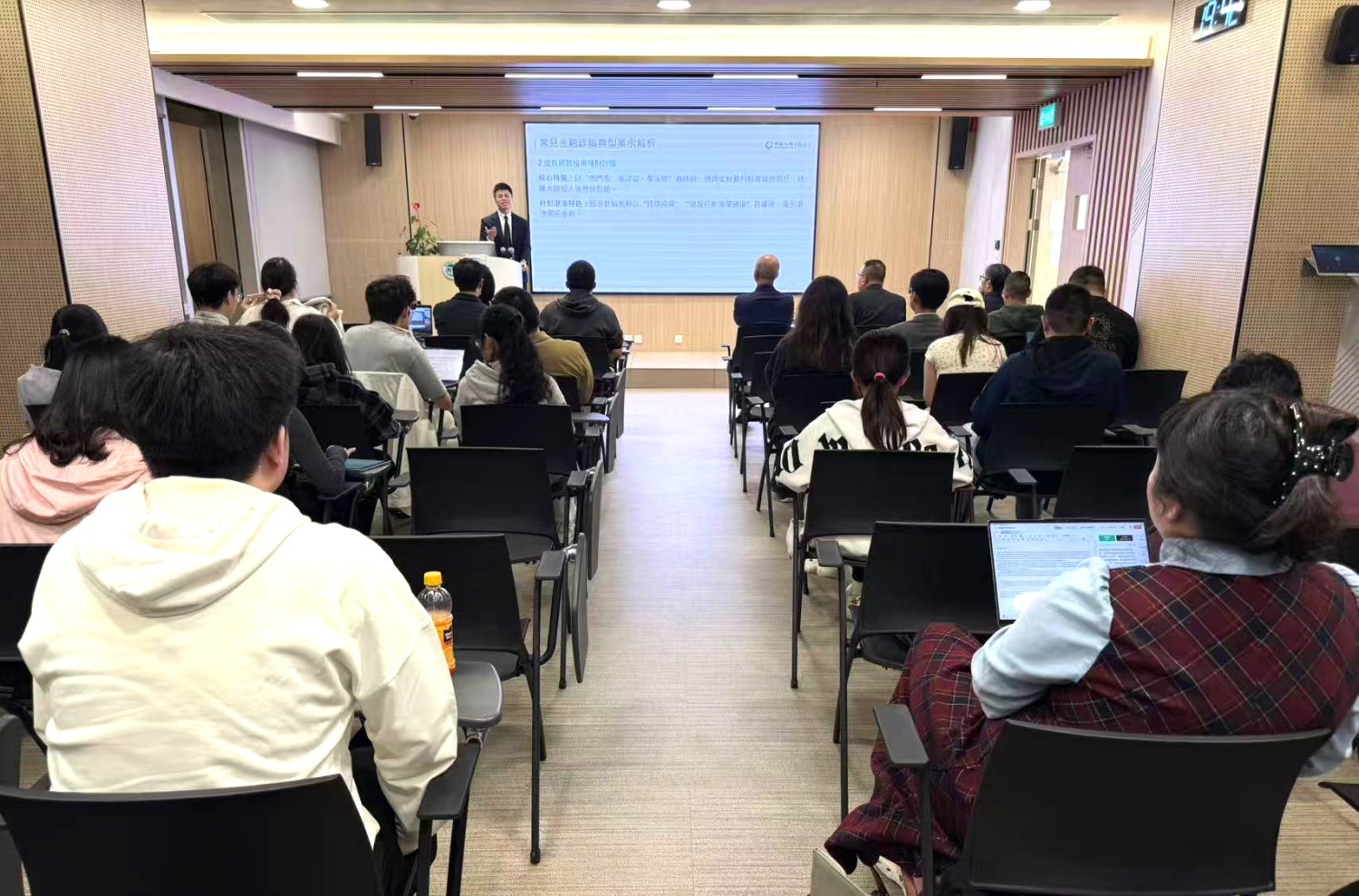
On 17th March 2026, the Faculty of Finance of City University of Macau held a finance seminar, China Life—Guangfa Bank Joint Lecture at Golden Dragon Campus, Macau. The seminar featured Mr. Lenpad Shi, Training Manager (Sales) and Team Support Supervisor of China Life Insurance (Overseas) Company Limited Macau Branch, was invited as the keynote speaker. The seminar focused on the theme: “Practical Tips for Identifying and Preventing Financial Fraud”. Distinguished guests included Mr. Paul Chan, Secretary-General of China Life-Macau Youth Association, Deputy General Manager of Agency Distribution Department, China Life Insurance (Overseas) Company Limited Macau Branch, Mr. Dino Kam, Senior Branch Manager of China Life Insurance (Oversea) Company Limited, as well as Dean Adrian Cheung and Associate Dean Eva Khong of the Faculty of Finance.
At the beginning of the seminar, Mr. Shi referenced official data from Mainland China, Hong Kong, and Macau, pointing out that financial fraud cases in these regions have continued to show a high-incidence and frequent trend in recent years. The amounts involved are substantial and growing rapidly, with a significant increase in the number of victims. Fraud techniques are constantly evolving and becoming more deceptive, posing a serious threat to social and economic order as well as the safety of people's property. Financial fraud methods are becoming increasingly specialized, organized, technology-driven, and concealed. Such fraud not only causes personal property losses, with some victims losing their life savings, leading to family conflicts, psychological trauma, and even extreme incidents, but also disrupts financial management order, undermines social trust systems, and affects economic stability and public safety.
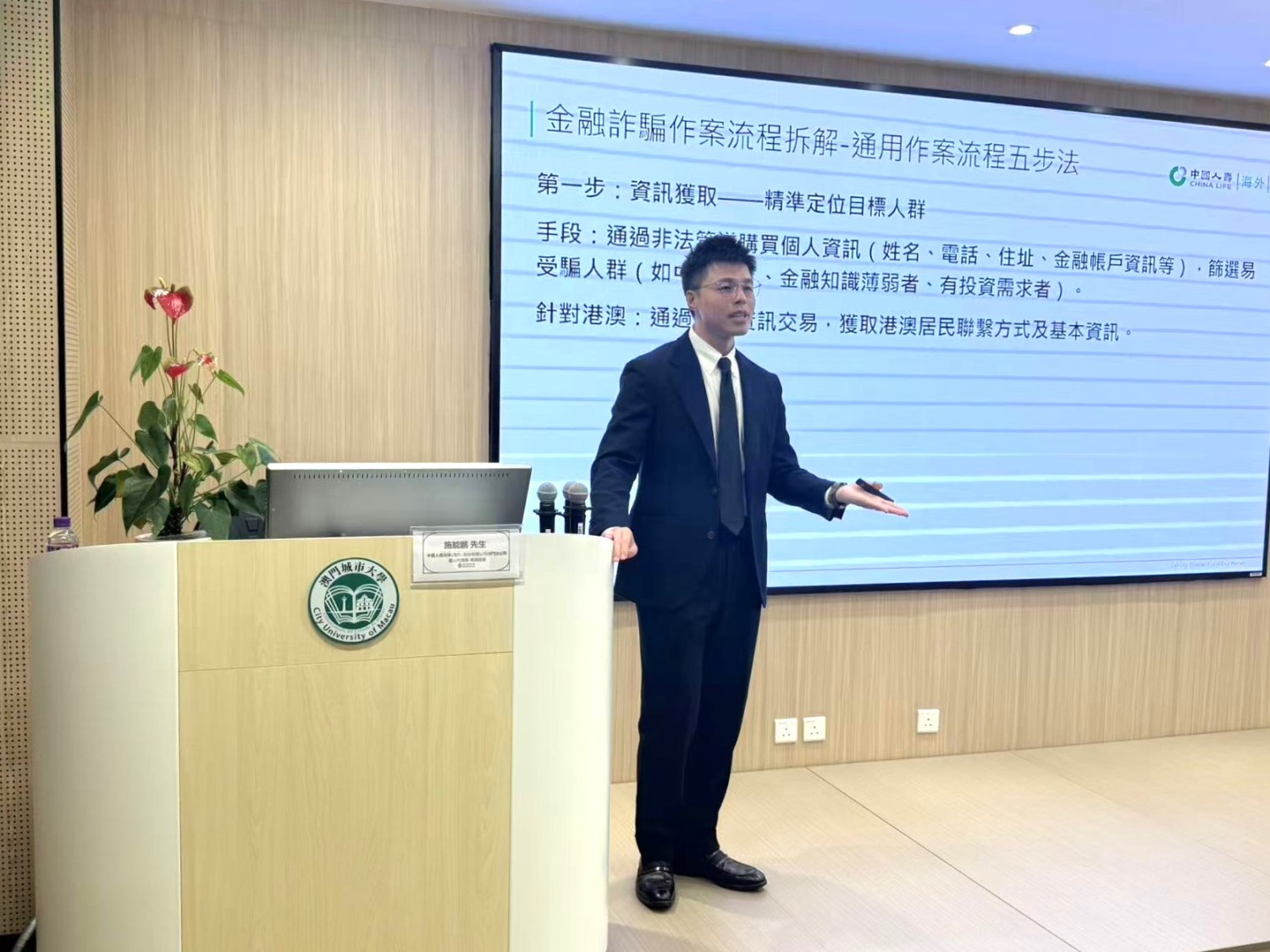
Mr. Shi conducted an in-depth analysis of six typical financial fraud cases: impersonation of public security, procuratorate, and court authorities or financial regulatory agencies; fraudulent online investment and wealth management fraud; impersonation of customer service or financial institution staff; "screen sharing" scams; virtual currency/blockchain-related fraud; and cross-border financial fraud (targeting residents of Hong Kong and Macau). Mr. Shi further explained the operational logic of fraud syndicates and deconstructed the typical fraud process, which includes information acquisition, initial contact, trust building, scripted persuasion, execution of the fraud, and final withdrawal. He analyzed practical methods for preventing financial fraud from three dimensions: "prevention beforehand, identification during the event, and handling afterward". The core principles of financial fraud prevention are: do not be greedy, do not trust, do not panic, and do not transfer funds. He also explained how to quickly identify suspicious situations within 30 seconds and verify identities through official channels, as well as how to reduce losses and effectively protect rights after being defrauded. Finally, he encouraged students to think about how to apply the knowledge gained in daily life to identify scams and urged them to share anti-fraud information with family and friends to collectively build a societal defense line against financial fraud.
During the seminar, Mr. Shi provided valuable information and guidance to the students, enhancing their understanding of financial security. The faculty and students of the Faculty of Finance once again thanked Mr. Shi for his insightful sharing. The faculty will continue to organize such events, and the students expressed that the opportunity to interact and exchange ideas with industry professionals was highly beneficial, eagerly anticipating more industry-related experiences.