


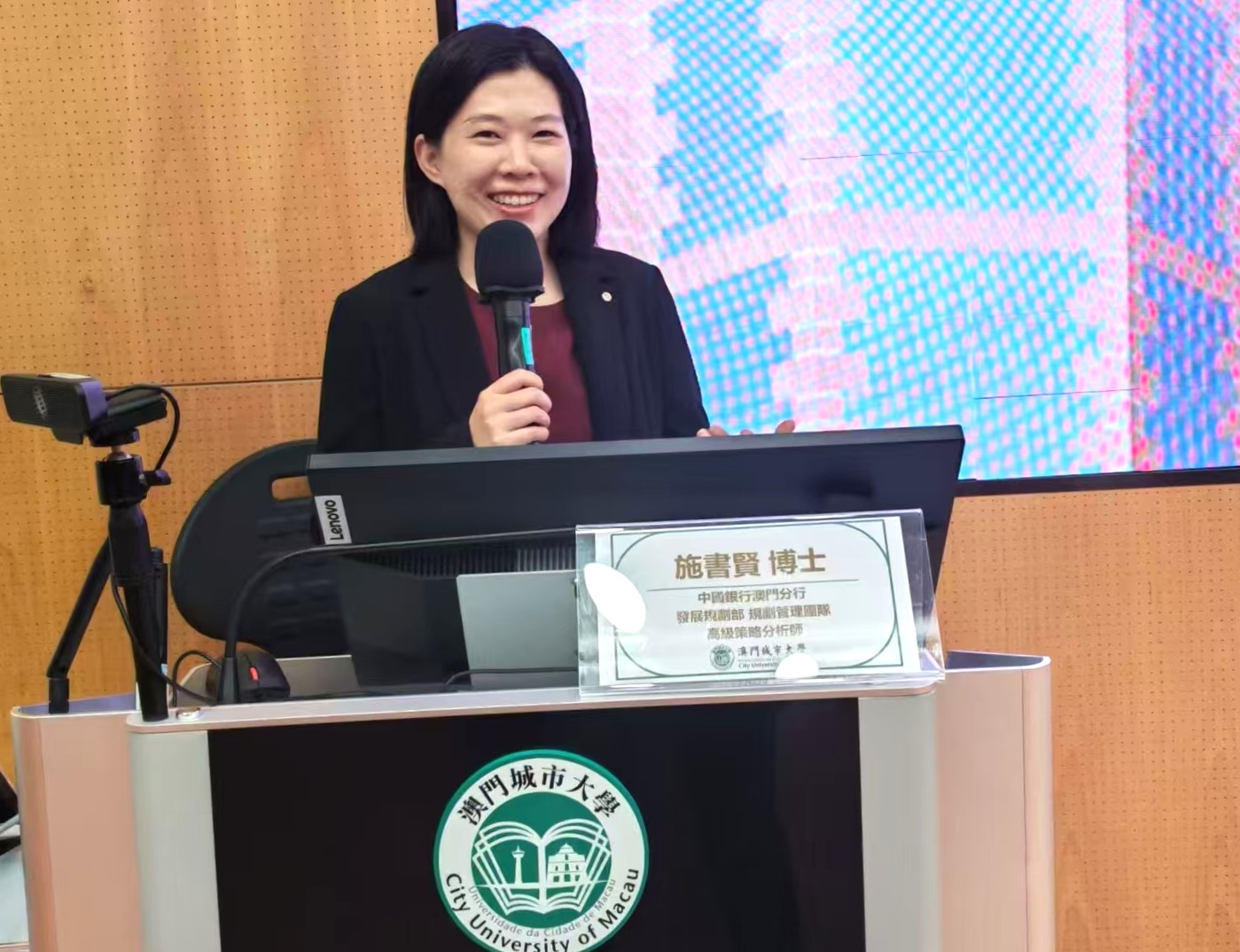
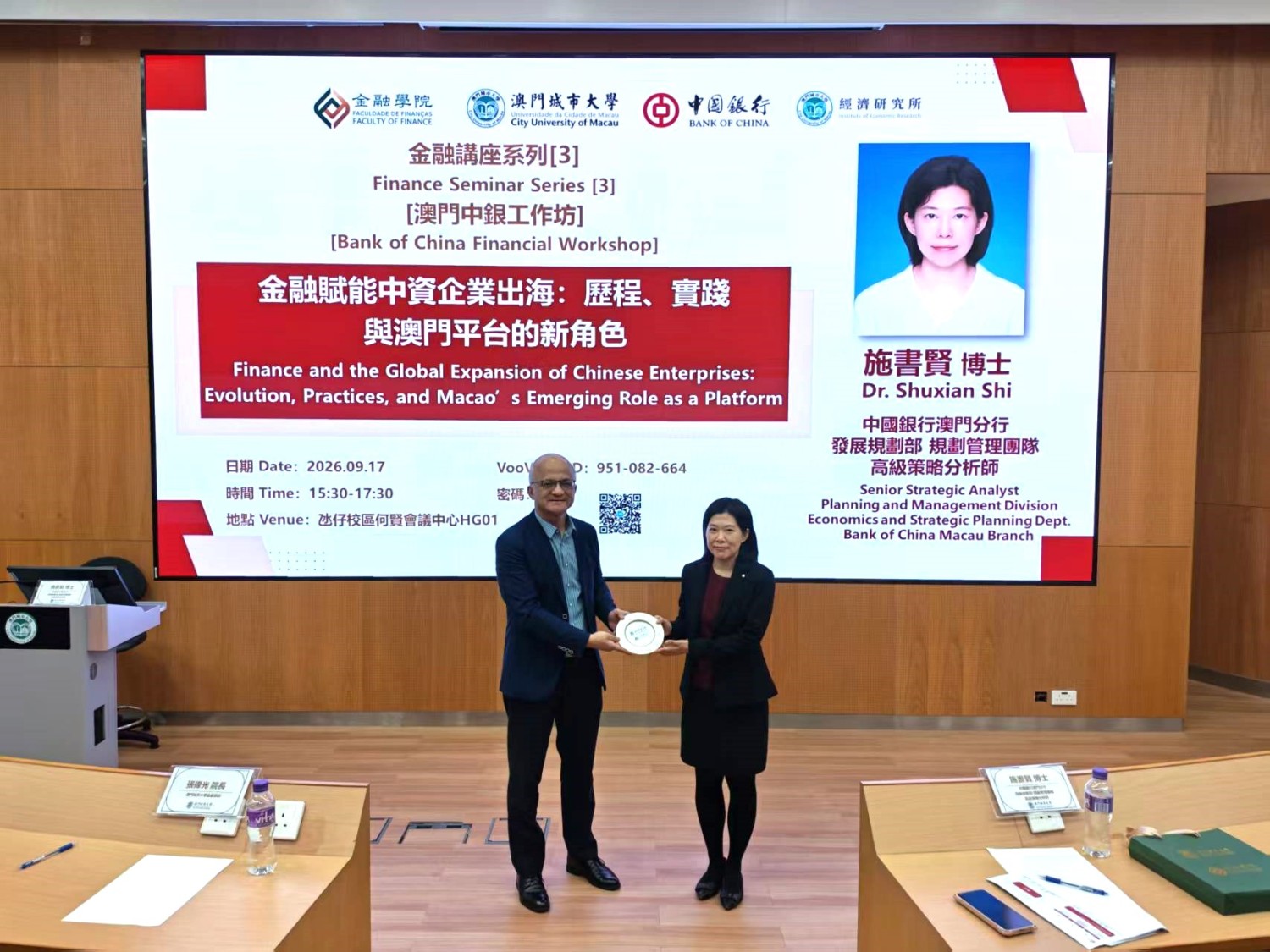
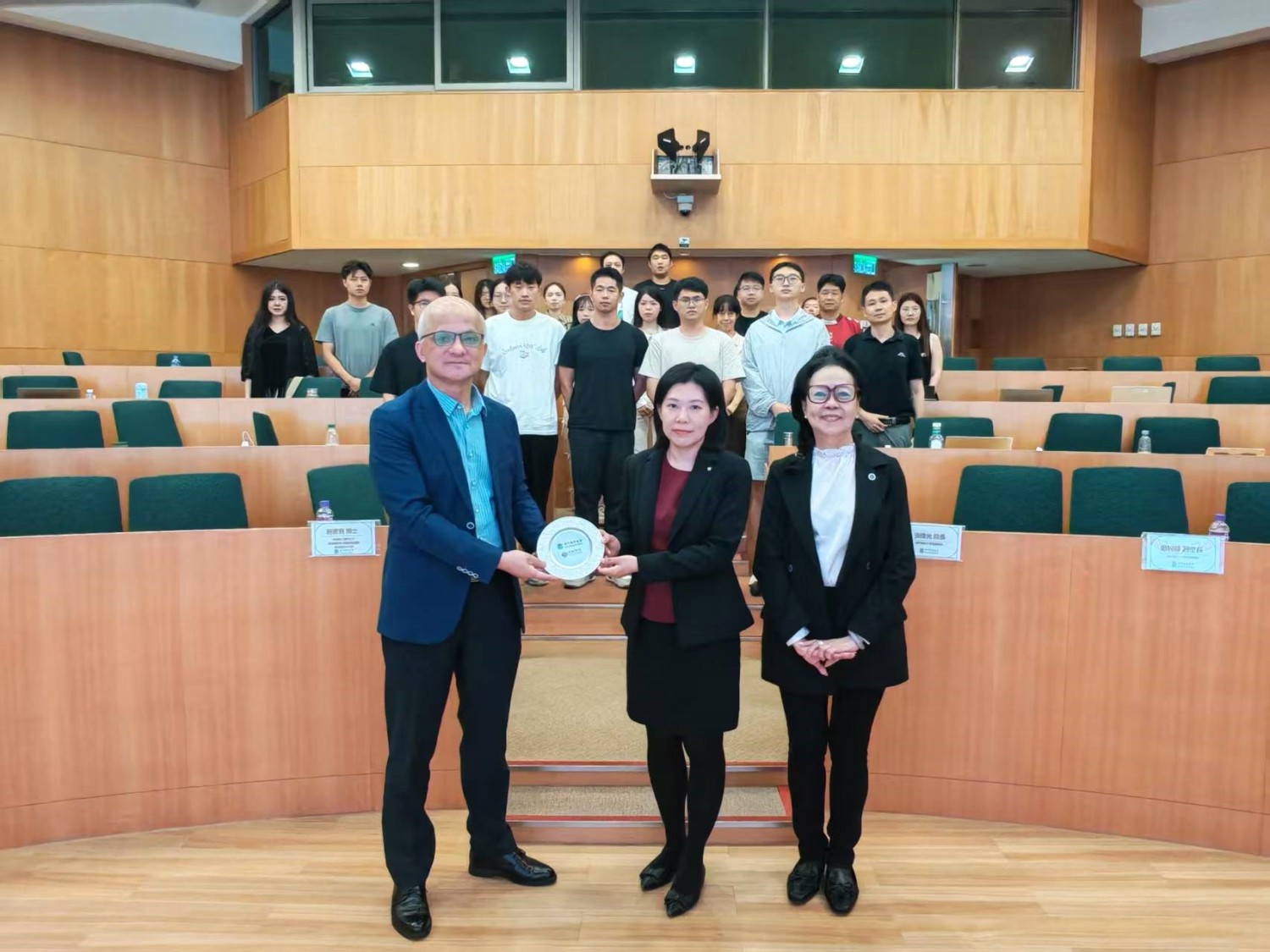
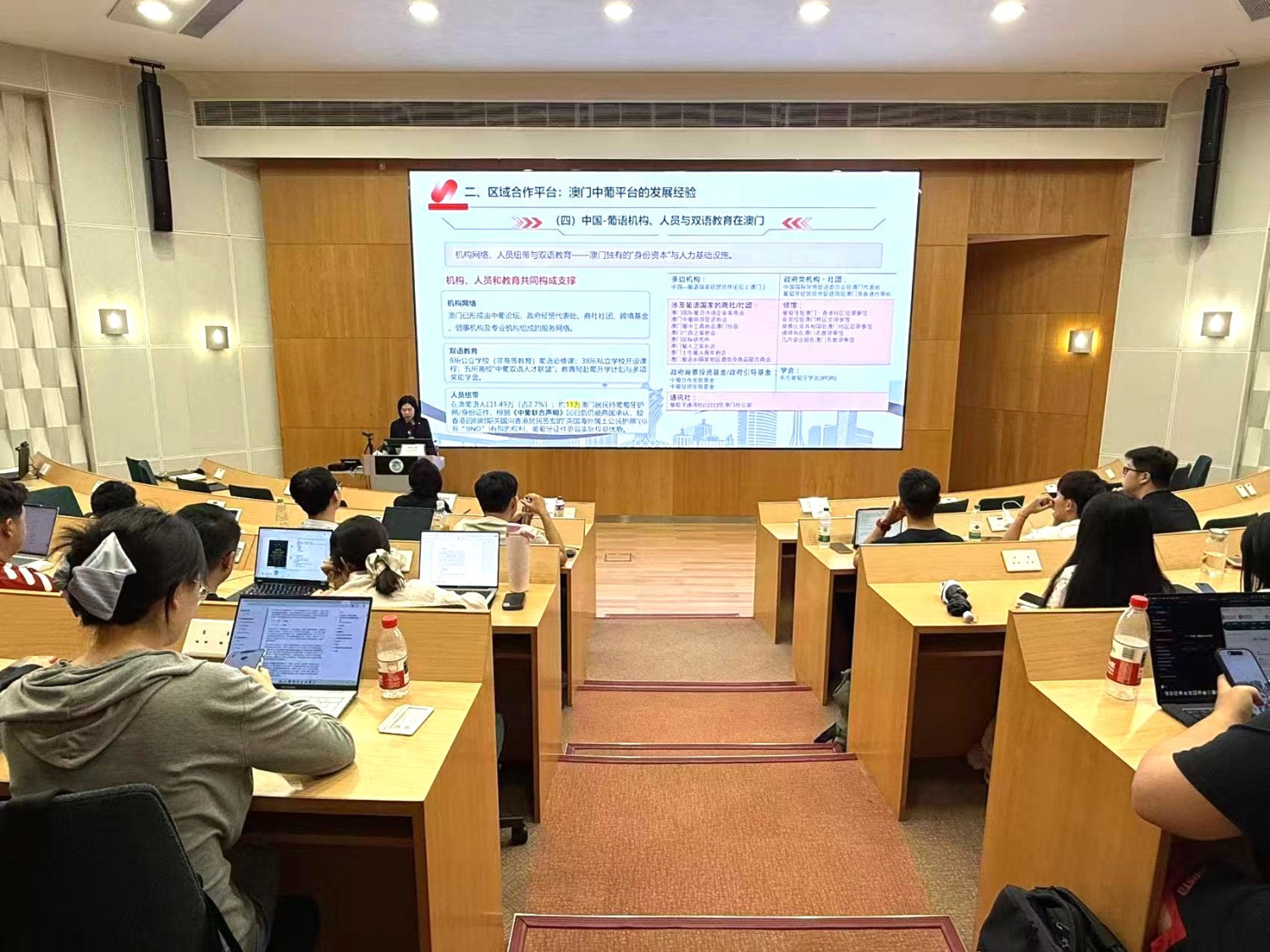
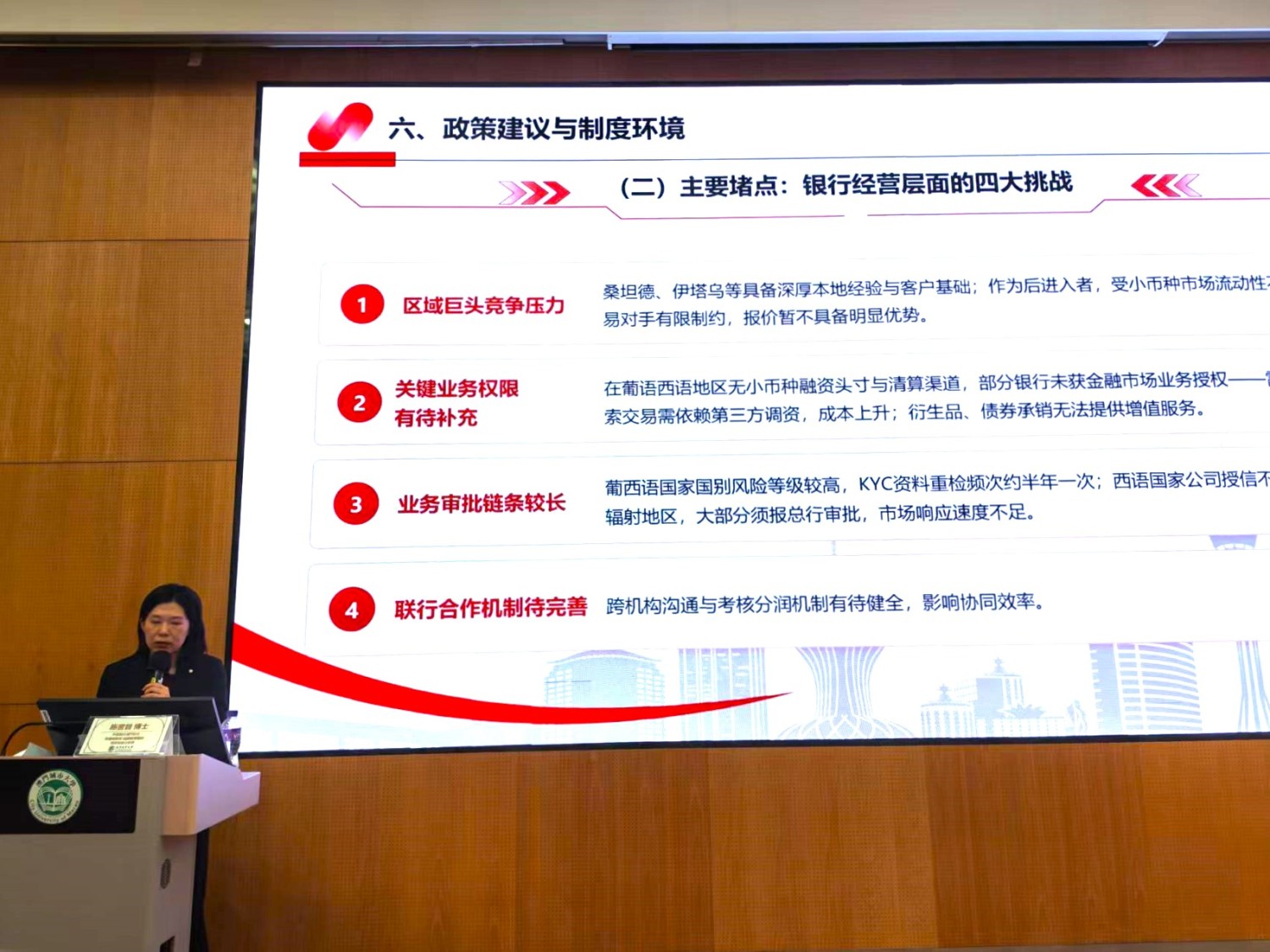
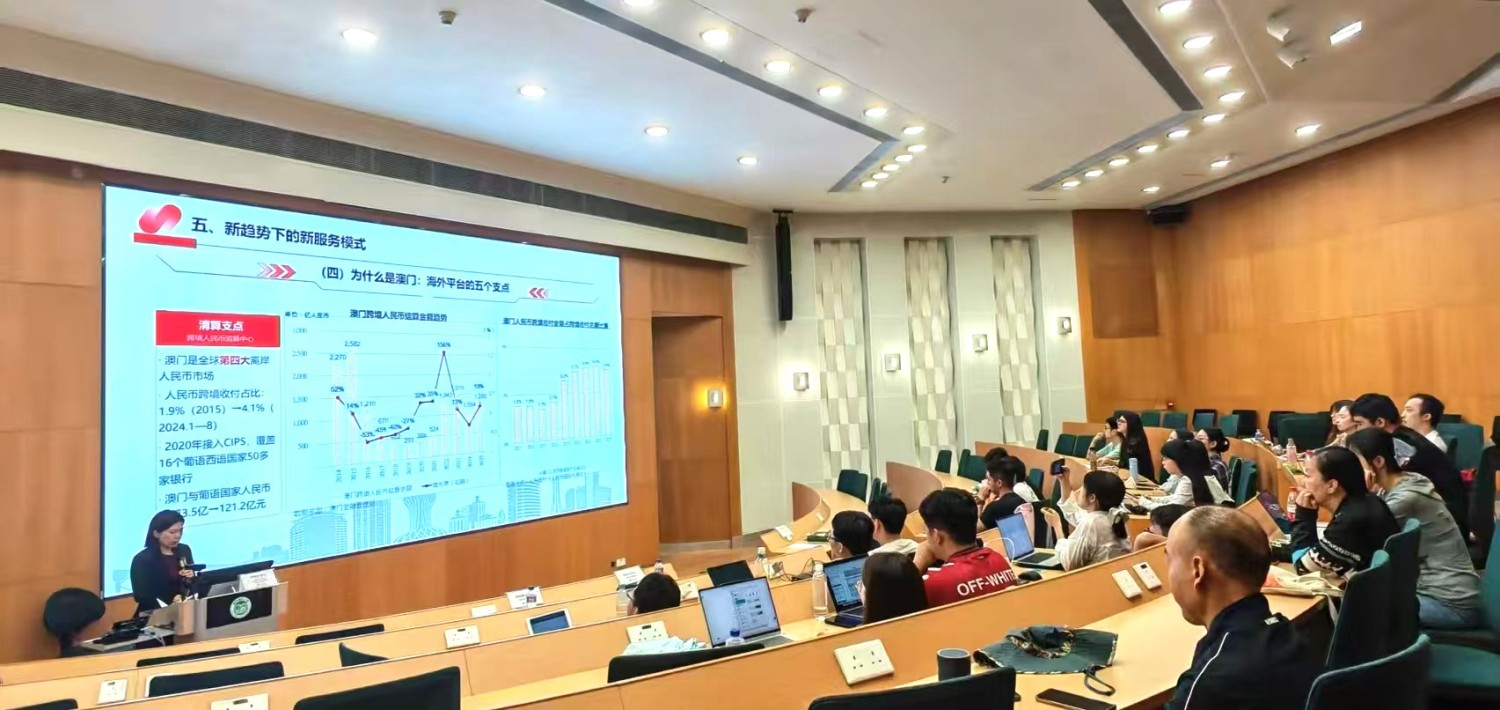
On September 17, 2026, the Faculty of Finance at City University of Macau held a finance seminar at Ho Yin Conference Center on Taipa Campus. The seminar featured Dr. Shuxian Shi, Senior Strategic Analyst of the Planning and Management Division, Economics and Strategic Planning Department of Bank of China Macau Branch, as the keynote speaker. The seminar focused on the theme "Finance and the Global Expansion of Chinese Enterprises: Evolution, Practices, and Macao’s Emerging Role as a Platform". Distinguished guests included Dean Adrian Cheung and Associate Dean Eva Khong from Faculty of Finance of City University of Macau.
Dr. Shuxian Shi works at Bank of China Macau Branch and the Macau Institute of Financial Research, serving as a Senior Strategic Analyst. Dr. Shi studied and exchanged in Portugal for two years and worked for three years at a subsidiary of a Global Fortune 500 Chinese enterprise in Brazil. During her time at Bank of China, she engaged in cross-border corporate banking business for many years and has served as an analyst for four years. Her research areas focus on regional and country studies and cross-border finance. From overseas study to overseas practical experience, from investment banking and asset management to the front line of cross-border finance, she has personally experienced the theme of "going global" from different perspectives.
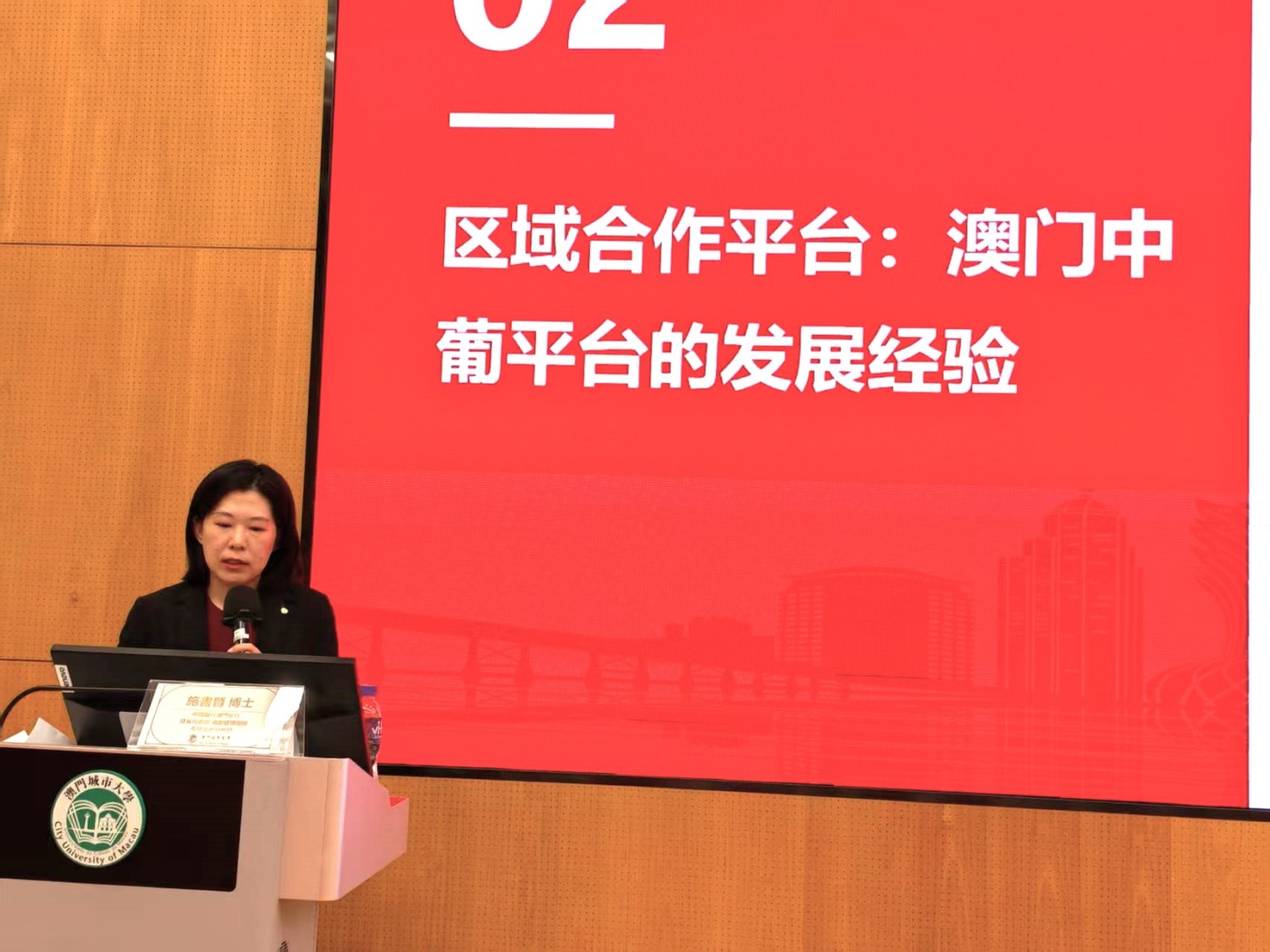
During the seminar, Dr. Shi Shuxian systematically reviewed the journey of Chinese enterprises going global and discussed the unique role of the Macau platform under the new situation. The seminar content covered six major sections. The first was the journey and core drivers of Chinese enterprises going global, examining changes in financial needs from the perspective of corporate evolution. Dr. Shi first pointed out that under the dual drivers of deep adjustments in the globalization landscape and the upgrading of domestic industrial structure, the internationalization strategy of Chinese enterprises is undergoing a transformation from "asset acquisition" to "ecosystem building"; the country is accelerating the improvement of the institutional environment and comprehensive service system supporting enterprises going global. Dr. Shi reviewed the three major driving forces and the four-stage evolution process of going global, compared the characteristics of financial services at each stage, and proposed three key words for financial needs at the current stage-integration, scenario-based service, and localization. At the same time, she analyzed the different logics of the two key markets, the Portuguese- and Spanish-speaking markets and the Association of Southeast Asian Nations (ASEAN) market, which give rise to completely different financial needs, as well as the cooperation opportunities driven by strategic synergy in the Portuguese- and Spanish-speaking markets. The second was regional cooperation platforms: the development experience of Macau's China-Portuguese platform. It explained the Macau platform path, advantages, and talent foundation. The seminar reviewed the evolution path and institutional characteristics of Macau's China-Portuguese platform, explained its unique advantages as a strategic fulcrum for enterprises going global, summarized the effectiveness of financial empowerment, and introduced the accumulation in Macau of Chinese and Portuguese institutions, personnel, and bilingual education, summarizing experience and constraints. The third was a comparative analysis of opportunities and challenges in different regional markets, comparing key countries and the ASEAN market. The fourth was practical cases of financial services for enterprises going global. Dr. Shi listed six typical cases, summarized the insights from the cases, and pointed out that financial services are upgrading toward integration and ecological development, emphasizing that financial needs depend on two dimensions: the stage in which the enterprise is located and the type of entity. The fifth was new service models under new trends, comparing traditional services and overseas platform services. At the end of the seminar, Dr. Shi reviewed the main bottlenecks at the Macau platform level and the bank operation level, and proposed five transformations for the adaptation of Macau's banking industry, namely: (1) Role transformation: from "following customers" to "leading transactions"; (2) Product adaptation: from standardization to various real business scenarios, providing one-stop localized package solutions for financing, hedging, settlement, and cash management; (3) Service deepening: by customer segment, matching differentiated service combinations for different stages of initial exploration, rapid growth, and mature development, accompanying enterprises throughout the entire life cycle of going global; (4) Ecological synergy: jointly building information-sharing and risk-sharing mechanisms with different units, and using "investment, loan, insurance, and leasing" linkages to undertake the comprehensive financial needs of large projects; (5) Capacity reserve: putting talent and research first. She also put forward policy recommendations respectively from the level of the Macau SAR and the national level. At the Macau SAR level, she proposed optimizing the tax environment, improving mechanism connectivity, improving the business environment, and broadening funding channels; at the national level, she proposed deepening rule coordination, coordinating "investment, loan, insurance, and leasing," expanding RMB scenarios, and supporting Macau in building a "Financial Service Center for China and Portuguese- and Spanish-speaking Countries," promoting the Macau platform to connect mainland resources and overseas markets. Ultimately, a "five-in-one" financial empowerment mechanism should be built to promote a replicable and scalable financial empowerment model.
The faculty and students of the Faculty of Finance sincerely thanked Dr. Shi for her wonderful sharing. The students said they benefited greatly. Through this seminar, they gained a more comprehensive understanding of the journey of Chinese enterprises going global, the practice of financial services, and the new role of the Macau platform. The seminar content was rich and comprehensive. The students expressed that they had the opportunity to exchange and interact with the industry and looked forward to more industry experiences.